The first steps of diplomacy: The correspondence between Timur and Charles VI
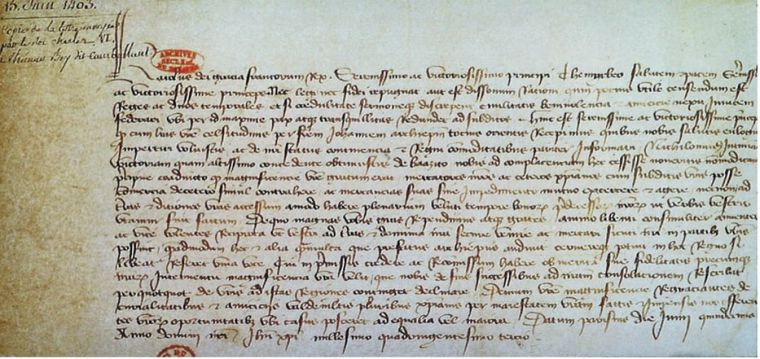
At the end of the 14th century, the correspondence between the great commander Amir Timur and King Charles VI of France, along with the memoirs of the Vatican envoy Ivan Grinlon about Timur’s court, are presented at the Center for Islamic Civilization in Uzbekistan. These documents represent not only a unique chapter in the history of diplomacy but also invaluable sources that introduce our nation’s scientific and cultural heritage to the world.
In the “Second Renaissance” section of the Center’s museum, early Islamic sources, medieval scholars’ manuscripts, and rare documents from the Timurid era are brought together in one space.
In the exhibition dedicated to the era of Amir Timur, every aspect of the sovereign’s activity state administration, domestic policy, and international relations is presented on a scholarly basis. Among the displayed materials are decrees, letters, and royal correspondences written in the Arabic script. One of them is a decree granted by Amir Timur to the descendants of the sayyids of Khwarazm, reflecting the great ruler’s profound respect for scholars.
“Each era has its own laws: over time, the number of artifacts decreases. Yet the survival of original sources from the period of Amir Timur is a great fortune for history”, says Sanjar G‘ulomov, Senior Research Fellow at the Institute of Oriental Studies, Academy of Sciences of Uzbekistan.
The most captivating part of the exhibition features the correspondence between Amir Timur, King Charles VI of France, and the Vatican. Written in 1402, these letters are among the earliest examples in the history of world diplomacy. Accompanying them is the Vatican envoy Ivan Grinlon’s work “Memoirs on the Court of Amir Timur”, which provides detailed information about court life, state governance, and international relations.
These documents show that Amir Timur was not only a great military leader but also a statesman with exceptional diplomatic skill. He established active political relations with France, the Vatican, China, India, and several other nations.
It should be noted that many of the exhibits displayed in the museum are original, centuries-old artifacts that have been carefully preserved. As previously reported, the correspondence between Amir Timur and King Charles VI of France was expected to arrive in Uzbekistan, and now these historic documents have rightfully taken their place in the museum’s collection. Moreover, with the help of modern technology, visitors can view the manuscripts digitally or explore them interactively.
Mohammed Said Amur Al-Hajri: Uzbekistan is a shining example of a modern presentation of historical heritage using advanced technologies

Dr. Mohammed Said Amur Al-Hajri, a member of the State Council of Oman (Senator) and a participant in the 1st International Forum of Islamic Civilization “The Path of Peace, tolerance and enlightenment” held on July 7–11 this year in cooperation with ICESCO, shared his impressions of the forum on his “X” social media page, reports Dunyo IA.
According to the Senator, International Forum, which brought together religious figures, scholars, researchers, thinkers, and experts from 80 countries, served as an important platform for strengthening inter-civilizational dialogue and promoting the ideas of tolerance and enlightenment.
High-ranking official from Oman noted that during the forum, he had the opportunity to familiarize himself with Uzbekistan's experience in the modern presentation of Islamic civilization heritage. In his view, the Center of Islamic Civilization in Tashkent, along with the scientific and educational complexes in Samarkand and Termez, are shining examples of how the rich heritage of great ancestors can be effectively transmitted to new generations, presenting history in an engaging and accessible format using modern technologies.
Furthermore, Dr. Mohammed Al-Hajri stated that in his report titled “Intellectual potential of Islamic Civilization: Historical experience and its examples”, presented within the framework of the forum, he paid special attention to the experience of the First and Second Renaissances in Uzbekistan. He characterized the Center of Islamic Civilization in Tashkent as a practical embodiment of a wise approach aimed at strengthening national development and nationwide unity.
“I was particularly pleased by the respect shown to Oman, its history, culture, and policy based on the principles of tolerance. Cultural cooperation between Uzbekistan and Oman relies on the shared spiritual values of our peoples”, - Senator wrote.
He also noted that during the meetings in Samarkand and Termez, he was once again able to experience the traditional hospitality and openness of the Uzbek people. In conclusion, the Senator expressed confidence that Uzbekistan, possessing a rich historical heritage, will continue to make a worthy contribution to the development of the Islamic world and all of humanity.