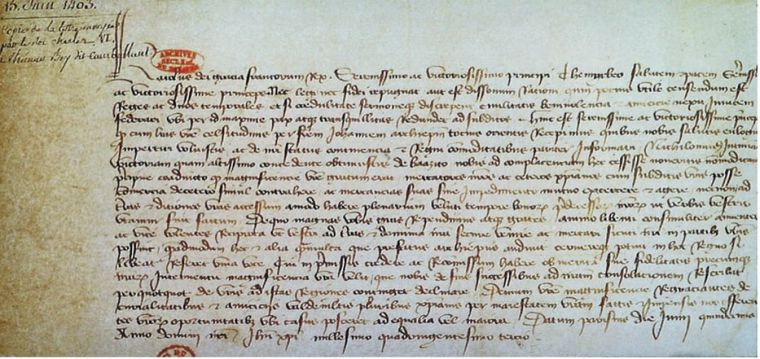
At the end of the 14th century, the correspondence between the great commander Amir Timur and King Charles VI of France, along with the memoirs of the Vatican envoy Ivan Grinlon about Timur’s court, are presented at the Center for Islamic Civilization in Uzbekistan. These documents represent not only a unique chapter in the history of diplomacy but also invaluable sources that introduce our nation’s scientific and cultural heritage to the world.
In the “Second Renaissance” section of the Center’s museum, early Islamic sources, medieval scholars’ manuscripts, and rare documents from the Timurid era are brought together in one space.
In the exhibition dedicated to the era of Amir Timur, every aspect of the sovereign’s activity state administration, domestic policy, and international relations is presented on a scholarly basis. Among the displayed materials are decrees, letters, and royal correspondences written in the Arabic script. One of them is a decree granted by Amir Timur to the descendants of the sayyids of Khwarazm, reflecting the great ruler’s profound respect for scholars.
“Each era has its own laws: over time, the number of artifacts decreases. Yet the survival of original sources from the period of Amir Timur is a great fortune for history”, says Sanjar G‘ulomov, Senior Research Fellow at the Institute of Oriental Studies, Academy of Sciences of Uzbekistan.
The most captivating part of the exhibition features the correspondence between Amir Timur, King Charles VI of France, and the Vatican. Written in 1402, these letters are among the earliest examples in the history of world diplomacy. Accompanying them is the Vatican envoy Ivan Grinlon’s work “Memoirs on the Court of Amir Timur”, which provides detailed information about court life, state governance, and international relations.
These documents show that Amir Timur was not only a great military leader but also a statesman with exceptional diplomatic skill. He established active political relations with France, the Vatican, China, India, and several other nations.
It should be noted that many of the exhibits displayed in the museum are original, centuries-old artifacts that have been carefully preserved. As previously reported, the correspondence between Amir Timur and King Charles VI of France was expected to arrive in Uzbekistan, and now these historic documents have rightfully taken their place in the museum’s collection. Moreover, with the help of modern technology, visitors can view the manuscripts digitally or explore them interactively.



 Iman
Iman  Prayer
  Fasting
  Zakat
Zakat  Haj
Haj  Qur`an
  Lessons of Islam
  Contact