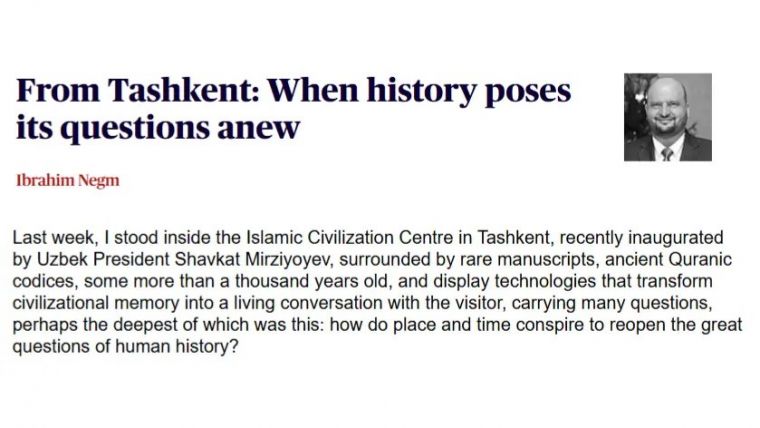
Egypt's largest daily newspaper “Al-Ahram” published an article by Ibrahim Negm, Senior Advisor to the Grand Mufti of Egypt, dedicated to his participation in the 1st International Forum of Islamic Civilization, which took place in Tashkent, Samarkand and Termez, reports Dunyo IA.
According to the author, the forum, held under the motto “The Path of Peace, tolerance and enlightenment”, exceeded all his expectations in terms of organization. Center of Islamic Civilization in Uzbekistan made a particularly profound and unforgettable impression on the scholar.
Article notes that the author was fascinated by the unique manuscripts, thousand-year-old copies of the Quran, and modern exhibition technologies presented at the Center. In his opinion, the past here is not merely displayed to visitors - thanks to modern museum solutions, each exhibit seems to acquire a new life.
Recalling his years of study at Harvard University, Ibrahim Negm discusses the theory of the “clash of civilizations”. He notes that despite the interpretation of this concept, according to which Islam was viewed as the main rival of the West, he had always doubted its scientific validity. According to the author, the Islamic civilization has never been in a state of stagnation and has never lagged behind global development.
During his visit to Uzbekistan, Ibrahim Negm visited historical and modern sites of the country's cultural and spiritual heritage, including the Center of Islamic Civilization, the Imam al-Bukhari complex, the Hakim al-Termizi mausoleum, and other shrines of the Islamic world. Based on the results of the trip, he concluded that the Islamic civilization and its rich spiritual and scientific heritage continue to dynamically develop, entering a new stage of their historical development.
Author also emphasizes that the Mushaf of Uthman, kept at the Center of Islamic Civilization, is one of the most valuable written relics not only of Uzbekistan but of the entire Islamic world. According to him, this manuscript represents a crucial source for studying the history of preserving the text of the Holy Quran in the first centuries of Islam.



 Iman
Iman  Prayer
  Fasting
  Zakat
Zakat  Haj
Haj  Qur`an
  Lessons of Islam
  Contact