OIC Calls for Stronger Global Action to Prevent and Address Disasters

On the International Day for Disaster Risk Reduction, observed annually on 13 October, the Organization of Islamic Cooperation (OIC) joins the international community in expressing solidarity with all victims of natural and human-made disasters around the world.
This year’s theme, “Fund Resilience, Not Disasters,” highlights the urgent need to invest in resilience-building and preventive measures rather than in post-disaster recovery.
The OIC underscores that disasters continue to impose heavy human and economic costs, severely affecting socio-economic development and posing existential threats to vulnerable communities across many of its Member States.
With several Member States frequently impacted by floods, epidemics, earthquakes, landslides, storms, and droughts, the OIC places high priority on disaster prevention and management, as emphasized in its Ten-Year Program of Action 2025.
Reaffirming its commitment, the OIC calls for stronger partnerships among Member States, international organizations, and local communities to develop effective strategies that enhance preparedness, reduce vulnerabilities, and improve recovery capacities.
“As disasters become more frequent and intense due to climate change and other global challenges, we must act collectively and decisively to build resilience and protect lives,” said H.E. Mr. Hissein Brahim Taha, Secretary-General of the OIC. “Investing in prevention today will save countless lives and resources tomorrow.”
The OIC also stresses the need to accelerate the implementation of the Sendai Framework for Disaster Risk Reduction, in line with national disaster management strategies and priorities.
Arab Media: Uzbekistan attracts foreign visitors with its rich Islamic Heritage and Modern Services
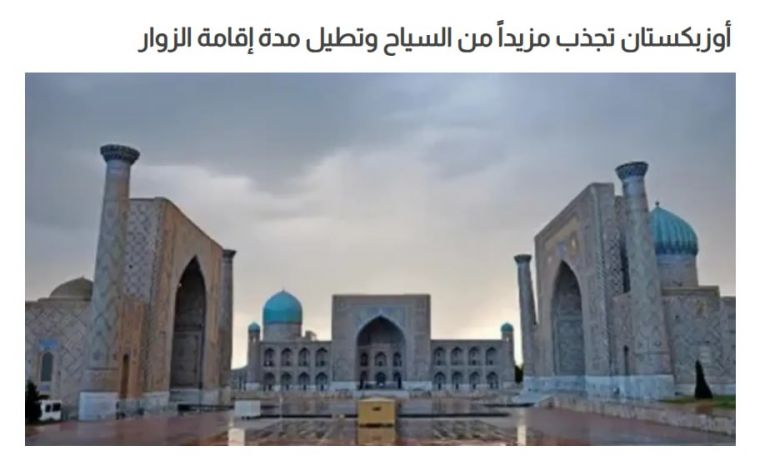
Articles highlighting Uzbekistan’s rich historical and cultural heritage and the rapid development of the tourism sector in the country have been published by popular Middle Eastern media outlets, including Saudi Arabia’s online magazine “Alhatun” and the website of Jordanian radio station “Seyahafm”, reports Dunyo IA.
In its article, “Tourism in Uzbekistan: A Destination of History and Islamic Architecture along the Silk Road”, Saudi publication “Alhatun” describes Uzbekistan as a pearl of Central Asia. Magazine highlights the country’s major tourism destinations – Samarkand, Bukhara, Khiva and Tashkent – identifying three key factors behind Uzbekistan’s appeal: its unique architectural and Islamic heritage along the Great Silk Road, the harmonious combination of antiquity and modernity, as well as traditional Eastern hospitality and cuisine.
In its publication, “Uzbekistan Attracts More Tourists and Extends Visitors’ Length of Stay”, Jordanian portal “Seyahafm” focuses on the dynamic growth of tourism-sector indicators. The article notes a 21.1 percent increase in international tourism arrivals during the first eight months of 2026, as well as significant growth in tourism services exports. The publication emphasizes that the simplification of the visa regime, expansion of the railway network and growth of hotel capacity have not only made travel around the country easier, but have also encouraged foreign visitors to stay in Uzbekistan longer and discover new regions.
