8 Facts About Bilal Ibn Rabah (RA)
1. Bilal Ibn Rabah (RA) was kept as slave
An Abyssinian, Bilal (RA) was kept as slave in Makkah. He (RA) was a slave of Ummayah bin Khalaf.
2 His master was a virulent enemy of Islam
Ummayah couldn’t tolerate the fact that Islam was being spread. Yet, Bilal (RA) his Ethiopian slave, converted into a Muslim.
Ummayah bin Khalaf was planning either to kill Him or to make him change his religion. But believe of Bilal (RA) on Allah didn’t let him fear from His master. He got succeeded in his plannings and sent Him for a punishment.
3. The inhuman punishment
In the Arabian Desert, Bilal (RA) was laid under the sparkling sun on the hot sand. Then, heavyweight hot rocks were placed on his body to make the situation worse.
He was burning due to the hot sand from the back of His body whereas, the upper body was burnt by the hot pieces of rocks. Also, He wasn’t able to move due to the weight of rocks.
4. The nights of lashes:
His believe made His master angrier. Bin Khalaf started lashing Him every night. He was tortured alternatively by Ummayah bin Khalaf and Abu Jahl.
5. Abu Bakr (RA)
Bilal (RA)’s punishment ended and He started living a free life as Abu Bakr (RA) bought him from Ummayah.
6. Bilal RA was the first Muezzin of Islam
Allah Almighty rewarded Him for His patience and He was made the Muazzin for the Mosque of Prophet (PBUH).
7. The death of Prophet Muhammad (PBUH):
After the death of Prophet (PBUH), Bilal (RA) wasn’t able to continue living in Madinah. He left Madina but returned after few days when He saw Prophet (PBUH) in a Dream demanding Him to pay a visit.
8. The request of Hasan and Hussain (RA):
When Bilal (RA) moved back in Madina, Hussain and Hasan (RA) requested Him to give Azan. After few years, Bilal (RA) finally left Madinah forever.
He died in Damascus in 20 AH. His tomb is located in Bab al Saghir, a graveyard in Damascus.
Hakim Termizi — a scholar who embodied the harmony of hadith scholarship and spiritual thought
The third century AH marked a highly advanced stage in the development of Islamic sciences, particularly the science of hadith. During this period, major scholarly efforts were undertaken to collect and classify hadiths, examine their chains of transmission and texts, and organize narrations according to various subjects. Great hadith scholars such as Imam Bukhari, Imam Muslim, Imam Darimi, and Abu Isa Termizi emerged from this vibrant intellectual environment. For this reason, the third century AH is widely regarded as the “golden age” of hadith scholarship.
One of the scholars from Transoxiana who made a significant contribution to the development of knowledge and spiritual thought during this period was Hakim Termizi. His scholarly legacy is especially important because it was not limited to collecting and transmitting hadiths, but also focused on understanding their deeper meanings, revealing their spiritual dimensions, and relating them to human life.
Studying Hakim Termizi’s scholarly views provides insight into how hadith scholarship developed during that period, how hadith scholars approached narrations, and how they sought to understand both the outward and inward meanings of hadiths.
A scholar nurtured in an intellectual environment
Hakim Termizi’s interest in knowledge was closely connected with his family environment. Sources note that his father was a hadith scholar who transmitted hadiths. Hakim Termizi himself also left accounts indicating that he grew up among people of learning from an early age.
He narrated more than 80 hadiths from his father. There are also reports that he received hadiths from his mother. The fact that his grandfathers on both his father’s and mother’s sides were also involved in hadith transmission further demonstrates that he was raised in a scholarly environment.
Hakim Termizi also had a wide circle of teachers and transmitters in the field of hadith. Studies mention the names of nearly 170 of his teachers, while his work Nawadir al-Usul records 223 transmitters. For this reason, biographical works of scholarly generations refer to Hakim Termizi not only by the title “al-Hakim” but also as “al-Hafiz.”
These details indicate that the scholar entered the field of hadith with substantial scholarly preparation. However, his intellectual profile cannot be defined merely by the number of transmitters or hadiths associated with him. Hakim Termizi’s distinctive character is revealed above all in his approach to hadith and his method of interpreting it.
From transmitting hadith to understanding its meaning
In his works, Hakim Termizi drew upon the Holy Qur’an, qudsi and Prophetic hadiths, reports from the Companions, the Tabi‘un and the generation that followed them, sayings of ascetics, and other sources. His aim, however, was not merely to compile these materials in one place.
The scholar paid particular attention to the meaning of hadiths, the ideas and wisdom they conveyed, and their significance in human life. In this respect, transmission and interpretation complement one another throughout his works.
Studies identify several distinctive features in Hakim Termizi’s approach to hadith. These include collecting hadiths with Sufi and spiritual themes and explaining their meanings, bringing together hadiths related to a particular subject, and interpreting hadiths in order to derive practical conclusions from them. These features are clearly reflected in such works as Al-Radd ‘ala al-Mu‘attila and Al-Manhiyyat.
Thus, for Hakim al-Tirmidhi, the value of a hadith did not lie solely in its transmission. Understanding its meaning, grasping its spiritual lessons, and applying them in life were equally important.
“Nawadir al-Usul” — interpreting meaning and substance
Hakim Termizi’s distinctive approach to hadith scholarship can be seen even more clearly in his work Nawadir al-Usul. The work is regarded as one of the important sources in the tradition of interpreting hadiths through a spiritual and mystical perspective. Alongside citing hadiths, it also explains their meanings, spiritual significance, and relevance to human life.
Hakim Termizi did not limit himself to the outward meaning of a hadith but also paid attention to its inner significance. This approach is also reflected in his juristic views. In addition to presenting the legal ruling derived from a hadith, he sought to reveal its ethical and spiritual dimensions.
Ibrohim Usmonov, Candidate of Historical Sciences, explains this distinctive feature of Hakim Termizi as follows:
“In this work, Hakim Termizi does not limit himself merely to collecting hadiths. Rather, he provides a detailed commentary on each hadith, explaining its outward and inward meanings and the wisdom it contains. He analyzes the content and essence of the hadith from various perspectives and seeks to reach its true core and comprehend it fully. A Sufi interpretation can be discerned throughout each of his commentaries. The work also demonstrates how hadiths can be applied to a person’s spiritual, inner, and everyday life.”
This observation highlights an important aspect of Hakim Termizi’s scholarly method. For him, the study of hadith did not end with memorizing or transmitting it. Understanding its meaning, grasping its wisdom, and demonstrating its place in human life were also regarded as essential parts of scholarship.
From this perspective, Nawadir al-Usul is considered one of the key works that reflects Hakim al-Tirmidhi’s scholarly worldview.
The question of isnad and matn
In hadith scholarship, the isnad—the interconnected chain of transmitters through whom a hadith was narrated—is of fundamental importance. Identifying through whom a hadith was transmitted, studying the narrators, and assessing their reliability were among the principal concerns of hadith scholars.
Hakim Termizi also paid close attention to the question of isnad. At the same time, his approach gave considerable importance to understanding the text and meaning of a hadith. He emphasized the need to clarify its meaning, examine its conformity with the Qur’an and Sunnah, and analyze both its outward and inward dimensions.
The scholar classified hadith transmitters into categories such as “ruwat,” “wu‘at,” and “naqqalun.” Through this classification, he demonstrated that hadith scholarship was not only about transmitting reports, but also about understanding them and comprehending their meanings.
At the same time, it is known that some of Hakim Termizi’s narrations were criticized by later hadith scholars. In particular, debates exist regarding the chains of transmission and narrators of certain hadiths in Nawadir al-Usul. Muhammad Taqi Usmani classified this work among the fourth tier of hadith collections and noted that it also contains weak hadiths.
Therefore, in studying Hakim Termizi’s legacy, it is important to distinguish between his method of interpreting hadiths and the aspects of certain narrations that remain debated from the perspective of hadith criticism.
“Manhiyyat” — the practical significance of hadith
Hakim Termizi’s approach to hadith scholarship is also clearly reflected in his work Al-Manhiyyat. The work contains more than 170 hadiths concerning prohibitions.
The author does not limit the discussion of each issue to a single hadith. To clarify its meaning, he draws on Qur’anic verses, other hadiths, the views of the Companions, the Tabi‘un, and other scholars. Where necessary, he also presents his own views. He then explains the meaning of the hadith and derives relevant conclusions from it.
The work addresses a variety of issues, including trade, debt, transactions involving gold and silver, and the use of water. This demonstrates that Hakim Termizi did not separate hadith from people’s everyday lives.
In his approach, hadith is connected not only with a person’s faith and acts of worship, but also with ethics, social dealings, and relationships within society.
Hakim Termizi’s legacy in the center’s exhibition
Hakim Termizi’s legacy, which has preserved its scholarly value for centuries, is today being widely studied and promoted in Uzbekistan as well.
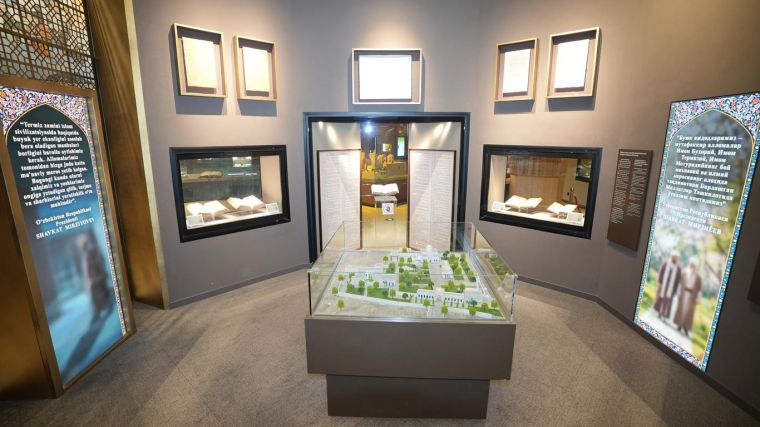
The First Renaissance Period exhibition at the Islamic Civilization Center in Uzbekistan extensively presents the scholarly heritage of the great scholars who emerged from this land. Within this exhibition, Hakim Termizi’s scholarly legacy also holds a worthy place.
The exhibition provides information about the scholars who played an important role in the flourishing of science, enlightenment, and intellectual thought in Transoxiana during the First Renaissance. The presentation of Hakim Termizi’s legacy in this setting helps convey to the wider public his distinctive place in the history of hadith scholarship and spiritual thought.
In particular, the emphasis in Hakim Termizi’s works on the harmony between knowledge and spirituality, hadith and jurisprudence, and transmission and interpretation makes it possible to view his legacy as an important component of the intellectual environment of the First Renaissance.
In this regard, the inclusion of the scholar’s legacy in the Center’s exhibition is not merely a presentation of historical information, but also a modern means of conveying to today’s generation the scholarly and spiritual heritage created by our ancestors.
From heritage to enlightenment
Hakim Termizi’s scholarly legacy demonstrates that, alongside hadith scholarship, jurisprudence, ethics, and Sufi thought also reached a high level of development in Transoxiana. In his works, the transmission and understanding of hadith, the interpretation of its meaning, and its application in life are closely interconnected.
Through works such as Nawadir al-Usul and Al-Manhiyyat, one can see the significance of hadiths in a person’s spiritual life, moral conduct, and everyday relationships.
Most importantly, Hakim Termizi’s legacy reminds us that knowledge is not merely about gathering information. Understanding knowledge, drawing sound conclusions from it, and applying it for human development are also among its essential purposes.
Today, the presentation of the scholar’s intellectual legacy in the First Renaissance Period exhibition at the Islamic Civilization Center in Uzbekistan reflects the continuity of this rich scholarly tradition. The ideas developed centuries ago by Hakim Termizi, who emerged from the land of Termez, are once again being introduced to the wider public through a modern museum and scholarly-educational environment.
In this sense, Hakim Termizi’s legacy is not only an important part of the history of hadith scholarship, but also one of the vivid examples of the advanced intellectual and spiritual thought that developed in our land.
Durdona Rasulova, iccu.uz

- «
- »