The site is working in test mode!
21 August, 2026   |   8 Rabī‘ al-awwal, 1448

Tashkent city
Fajr
04:12
Sunrise
05:38
Dhuhr
12:26
Asr
17:14
Maghrib
19:18
Isha
20:39
Bismillah
21 August, 2026, 8 Rabī‘ al-awwal, 1448

8 Facts About Bilal Ibn Rabah (RA)

14.10.2025   44061   2 min.
8 Facts About Bilal Ibn Rabah (RA)

1. Bilal Ibn Rabah (RA) was kept as slave

An Abyssinian, Bilal (RA) was kept as slave in Makkah. He (RA) was a slave of Ummayah bin Khalaf.

2 His master was a virulent enemy of Islam

Ummayah couldn’t tolerate the fact that Islam was being spread. Yet, Bilal (RA) his Ethiopian slave, converted into a Muslim.

Ummayah bin Khalaf was planning either to kill Him or to make him change his religion. But believe of Bilal (RA) on Allah didn’t let him fear from His master. He got succeeded in his plannings and sent Him for a punishment.

3. The inhuman punishment

In the Arabian Desert, Bilal (RA) was laid under the sparkling sun on the hot sand. Then, heavyweight hot rocks were placed on his body to make the situation worse.

He was burning due to the hot sand from the back of His body whereas, the upper body was burnt by the hot pieces of rocks. Also, He wasn’t able to move due to the weight of rocks.

4. The nights of lashes:

His believe made His master angrier. Bin Khalaf started lashing Him every night. He was tortured alternatively by Ummayah bin Khalaf and Abu Jahl.

5. Abu Bakr (RA)

Bilal (RA)’s punishment ended and He started living a free life as Abu Bakr (RA) bought him from Ummayah.

6. Bilal RA was the first Muezzin of Islam

Allah Almighty rewarded Him for His patience and He was made the Muazzin for the Mosque of Prophet (PBUH).

7. The death of Prophet Muhammad (PBUH):

After the death of Prophet (PBUH), Bilal (RA) wasn’t able to continue living in Madinah. He left Madina but returned after few days when He saw Prophet (PBUH) in a Dream demanding Him to pay a visit.

8. The request of Hasan and Hussain (RA):

When Bilal (RA) moved back in Madina, Hussain and Hasan (RA) requested Him to give Azan. After few years, Bilal (RA) finally left Madinah forever.

He died in Damascus in 20 AH. His tomb is located in Bab al Saghir, a graveyard in Damascus.

Other posts

“Russia News”: Final Declaration of the Forum adopted in Tashkent will serve to restore the Heritage of Islamic Civilization

16.07.2026   61414   2 min.
 “Russia News”: Final Declaration of the Forum adopted in Tashkent will serve to restore the Heritage of Islamic Civilization

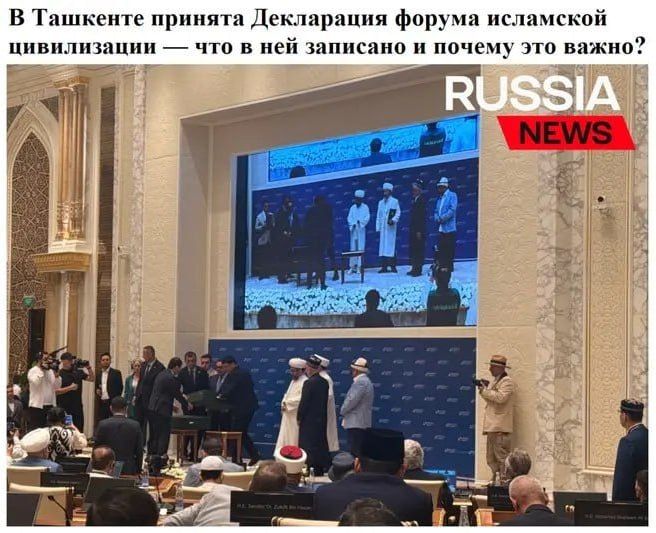
Russian online publication “Russia News” has published an article titled “Declaration of the Islamic Civilization Forum adopted in Tashkent - What is written in it and why is it important?”, reports Dunyo IA.

Publication states that following the 1st International Forum of Islamic Civilization “The Path of Peace, tolerance and enlightenment”, a Declaration was adopted, which outlines a number of concrete initiatives for the revival and promotion of the humanistic heritage of Islamic civilization.

It is noted that the starting point of the Declaration is the initiative of the President of Uzbekistan, Shavkat Mirziyoyev, voiced back in 2017 from the rostrum of the UN General Assembly. At that time, he proposed to engage in the revival and promotion of the humanistic heritage of Islamic civilization. This resulted in the creation of the Center of Islamic Civilization in Uzbekistan and ultimately, the forum itself.

Document was signed by representatives from more than 40 countries. At its core is a simple but important idea: Islamic civilization has made a tremendous contribution to global science, culture, and education, and this contribution is undeservedly underestimated. This is especially true against the backdrop of the fact that Islamophobia, xenophobia and simply distorted perceptions of Islam remain prevalent in the world.

Publication also notes a number of initiatives aimed at preserving and popularizing the Islamic civilizational heritage. Among them are the creation of the World Alliance of Islamic Civilization, digital platforms and libraries, international research programs, awards, funds, an encyclopaedia, as well as platforms for cooperation among scholars, museums, and youth. All proposals have been submitted to the International Council of the Forum for the development of a roadmap for their implementation until 2030.

In conclusion, the publication notes that the Declaration is viewed not as a finality, but as a starting point for further implementation.