The site is working in test mode!
12 August, 2026   |   29 Ṣafar, 1448

Tashkent city
Fajr
03:59
Sunrise
05:29
Dhuhr
12:28
Asr
17:23
Maghrib
19:31
Isha
20:58
Bismillah
12 August, 2026, 29 Ṣafar, 1448

8 Facts About Bilal Ibn Rabah (RA)

14.10.2025   42683   2 min.
8 Facts About Bilal Ibn Rabah (RA)

1. Bilal Ibn Rabah (RA) was kept as slave

An Abyssinian, Bilal (RA) was kept as slave in Makkah. He (RA) was a slave of Ummayah bin Khalaf.

2 His master was a virulent enemy of Islam

Ummayah couldn’t tolerate the fact that Islam was being spread. Yet, Bilal (RA) his Ethiopian slave, converted into a Muslim.

Ummayah bin Khalaf was planning either to kill Him or to make him change his religion. But believe of Bilal (RA) on Allah didn’t let him fear from His master. He got succeeded in his plannings and sent Him for a punishment.

3. The inhuman punishment

In the Arabian Desert, Bilal (RA) was laid under the sparkling sun on the hot sand. Then, heavyweight hot rocks were placed on his body to make the situation worse.

He was burning due to the hot sand from the back of His body whereas, the upper body was burnt by the hot pieces of rocks. Also, He wasn’t able to move due to the weight of rocks.

4. The nights of lashes:

His believe made His master angrier. Bin Khalaf started lashing Him every night. He was tortured alternatively by Ummayah bin Khalaf and Abu Jahl.

5. Abu Bakr (RA)

Bilal (RA)’s punishment ended and He started living a free life as Abu Bakr (RA) bought him from Ummayah.

6. Bilal RA was the first Muezzin of Islam

Allah Almighty rewarded Him for His patience and He was made the Muazzin for the Mosque of Prophet (PBUH).

7. The death of Prophet Muhammad (PBUH):

After the death of Prophet (PBUH), Bilal (RA) wasn’t able to continue living in Madinah. He left Madina but returned after few days when He saw Prophet (PBUH) in a Dream demanding Him to pay a visit.

8. The request of Hasan and Hussain (RA):

When Bilal (RA) moved back in Madina, Hussain and Hasan (RA) requested Him to give Azan. After few years, Bilal (RA) finally left Madinah forever.

He died in Damascus in 20 AH. His tomb is located in Bab al Saghir, a graveyard in Damascus.

Other posts
News

“Kyiv Diplomatic”: Bukhara strengthens its position as an International Cultural Centre

05.08.2026   28243   2 min.
 “Kyiv Diplomatic”: Bukhara strengthens its position as an International Cultural Centre

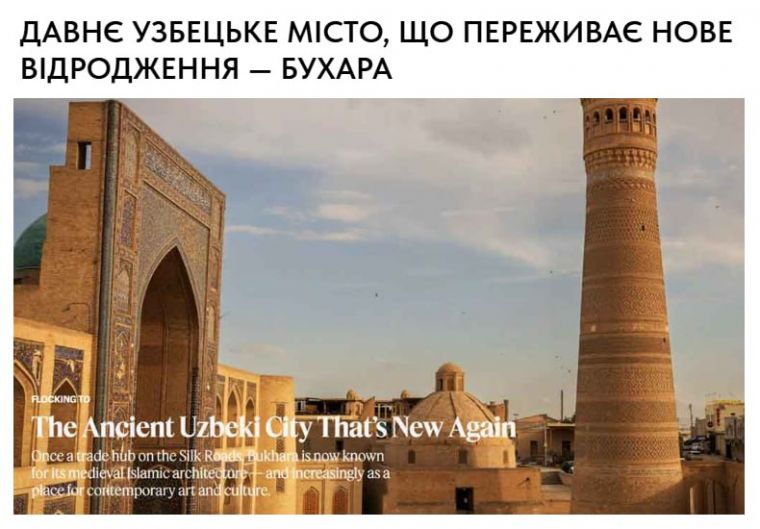
Today ancient Bukhara is once again strengthening its position as an international cultural centre and experiencing a new stage of cultural and tourism development, reports Dunyo IA correspondent, citing with reference to the Ukrainian magazine “Kyiv Diplomatic”.

Publication notes that the American newspaper “The New York Times” published an article dedicated to Bukhara, one of the oldest cities in Uzbekistan. For more than a thousand years, Bukhara remained one of the most important centres of the Great Silk Road, connecting the East and the West. Trade routes passed through the city, along which jewellery, textiles, porcelain, and other valuable goods were transported. From the 8th to the 13th centuries, Bukhara became one of the largest intellectual and cultural centres of the Islamic world, where outstanding scholars, architects, mathematicians and artists worked.

Authors of the publication pay particular attention to the city’s rich historical and architectural heritage. Bukhara has preserved the ancient Ark Fortress, mausoleums, madrasas, mosques with distinctive turquoise domes, and other landmarks, many of which are included in the UNESCO World Heritage List. More than 140 sites of the historic center are located within walking distance of one another, making the city one of the best-preserved historical complexes in Central Asia.

According to the publication, today Bukhara is once again strengthening its position as an international cultural center. One of the most important events was the first Bukhara Biennial of Contemporary Art, held in the autumn of last year. As part of the project, artists from Uzbekistan and other countries created works specifically for the city’s historic spaces, collaborated with local artisans and participated in joint cultural initiatives.

As noted in the publication, the organization of the Biennial contributed not only to the promotion of cultural heritage but also to the development of tourism infrastructure. New hotels, restaurants, cultural spaces and shops are opening in Bukhara, catering to the growing interest of international travellers.

“The New York Times” also presented its own city guide, recommending that tourists visit historical landmarks, including the Sitorai Mokhi-Khosa Palace, Chor-Bakr Memorial Complex, Baland Mosque and Khoja Zayniddin Sufi Complex.