The site is working in test mode!
21 August, 2026   |   8 Rabī‘ al-awwal, 1448

Tashkent city
Fajr
04:12
Sunrise
05:38
Dhuhr
12:26
Asr
17:14
Maghrib
19:18
Isha
20:39
Bismillah
21 August, 2026, 8 Rabī‘ al-awwal, 1448

The Muslim World League

15.10.2025   108385   5 min.
The Muslim World League

The Muslim World League (MWL) is an independent international organization comprising members from various Islamic countries and sects. Headquartered in Makkah, its mission is to clarify the true image of Islam and foster friendship among peoples.

Establishment:
The MWL was established by a resolution issued by the General Islamic Conference held in Makkah on May 18, 1962 (corresponding to 14 Dhu al-Hijjah 1381 AH).

The MWL Serves as a Member in:

  • United Nations (UN): The MWL serves as an observer member in the Economic and Social Council, among international non-governmental organizations holding consultative status.
  • Organization of Islamic Cooperation (OIC): The MWL serves as an observer, participating in summit conferences, meetings of foreign ministers, and all other conferences convened by the organization.
  • United Nations Educational, Scientific and Cultural Organization (UNESCO): The MWL serves as a member.
  • United Nations Children’s Fund (UNICEF): The MWL serves as a member.

Its Charter:
We, the members of the Muslim World League, representing the MWL with faith and conviction, pledge to Almighty Allah to:

  • Call upon all nations to work toward achieving the happiness and welfare of humanity, ensuring social justice for all, and fostering the best possible human society.
  • Bear witness before Allah that we do not seek to harm or interfere in the affairs of others, nor do we desire to dominate or exert control over anyone.
  • Strive to unify Muslims and eliminate the causes of division within Islamic societies across the world.
  • Promote and encourage all forms of benevolence.
  • Declare that Islam does not endorse populism or racism.
  • Unite our efforts to achieve these goals in a constructive and principled manner.
  • Utilize all available spiritual, material, and moral means to fulfill the aspirations outlined in this charter.

The MWL’s Objectives and Methods of Implementation:
The MWL pursues its goals through means that fully comply with Islamic law, including the following:

  • Introduce Islam and its tolerant values as presented in the Holy Qur’an and the Sunnah.
  • Consolidate the principles of centrism and moderation within the consciousness of the Muslim Ummah.
  • Address and resolve issues facing the Muslim Ummah and prevent factors that cause conflict and discord.
  • Emphasize civilizational rapprochement and promote a culture of dialogue.
  • Address the concerns of Muslim minorities and resolve their issues in accordance with the constitutions and legal frameworks of the countries in which they reside.
  • Utilize the Hajj season as an opportunity to facilitate meetings among scholars, intellectuals, and organizational leaders to provide scientific and practical solutions for raising the standards of Muslims worldwide.
  • Preserve the Islamic identity of the Ummah, strengthen its global standing, and enhance its unity.

Financial Management:
The Muslim World League relies on its endowments for financial management.
Investments derived from these endowments constitute a major source of funding for the organization.

The General Secretariat:
The General Secretariat of the Muslim World League serves as the executive arm of the organization. It oversees the day-to-day operations of the League and implements the policies and resolutions adopted by the Supreme Council. This is carried out under the leadership of the Secretary-General, with the support of assistant secretaries and the general administrative staff.

Headquarters:
Kingdom of Saudi Arabia
Makkah, Al-Aqaba District
P.O. Box 537
Tel: +966-12-5309444
Fax: +966-12-5601319 / +966-12-5601267

Other posts

“Colombo Times”: Implementation of the Third Renaissance Idea becomes a state policy of Uzbekistan

12.08.2026   56427   3 min.
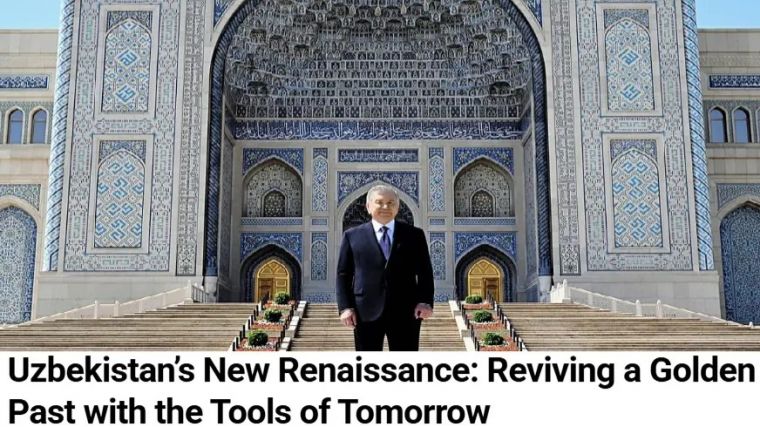
 “Colombo Times”: Implementation of the Third Renaissance Idea becomes a state policy of Uzbekistan

The Sri Lankan online publication Colombo Times has published an analytical article titled “Uzbekistan’s New Renaissance: Reviving a Golden Past with the Tools of Tomorrow”, reports Dunyo IA.

Publication, prepared by renowned Sri Lankan journalist Fazan Nawaz, focuses on the reforms carried out in Uzbekistan over the past decade under the leadership of President Shavkat Mirziyoyev, aimed at building the New Uzbekistan and implementing the idea of the Third Renaissance, as well as their significant outcomes.

“At the very heart of Central Asia, a quiet yet far-reaching revolution in its significance is taking place. This struggle is being waged not with weapons, but through manuscripts, museums and microchips. Under the leadership of President Shavkat Mirziyoyev, Uzbekistan is seeking to revive the glory of the medieval “Golden Age”, when such cities as Samarkand and Bukhara were leading centers of global science, poetry, and philosophy, author writes. - The distinctive feature of this process lies in the fact that Uzbekistan is actively using artificial intelligence and digital technologies to preserve, restore, and promote cultural heritage spanning more than a thousand years of history”.

Publication also highlights Uzbekistan’s rich cultural and historical heritage and the reforms being implemented to preserve it. It notes that this land has been the cradle of many outstanding scholars and thinkers throughout human history.

 “Leader of Uzbekistan frequently refers to this historical heritage, emphasizing that Mirzo Ulugbek was not only a great scholar but also a statesman for whom science was the highest value. The current process of renewal is referred to by the Head of State as the ‘Third Renaissance’, viewing it as a nationwide project aimed at restoring Uzbekistan’s role as a center of science, education, and culture. According to historians, this term denotes a new stage of revival following two great periods of flourishing that had previously existed in the region”, article notes.

Article emphasizes that an important feature of Uzbekistan’s approach, distinguishing it from other countries, is the use of artificial intelligence not only as a tool for economic development but also as a means of protecting cultural heritage.

Fazan Nawaz concludes his article by stating that only time will show whether the “Third Renaissance” will be able to fully achieve its objectives. However, it is already clear today which path Uzbekistan is pursuing.