The site is working in test mode!
27 November, 2026   |   17 Jumādá al-ākhirah, 1448

Tashkent city
Fajr
06:01
Sunrise
07:20
Dhuhr
12:16
Asr
15:15
Maghrib
16:59
Isha
18:16
Bismillah
27 November, 2026, 17 Jumādá al-ākhirah, 1448

The Muslim World League

15.10.2025   188951   5 min.
The Muslim World League

The Muslim World League (MWL) is an independent international organization comprising members from various Islamic countries and sects. Headquartered in Makkah, its mission is to clarify the true image of Islam and foster friendship among peoples.

Establishment:
The MWL was established by a resolution issued by the General Islamic Conference held in Makkah on May 18, 1962 (corresponding to 14 Dhu al-Hijjah 1381 AH).

The MWL Serves as a Member in:

  • United Nations (UN): The MWL serves as an observer member in the Economic and Social Council, among international non-governmental organizations holding consultative status.
  • Organization of Islamic Cooperation (OIC): The MWL serves as an observer, participating in summit conferences, meetings of foreign ministers, and all other conferences convened by the organization.
  • United Nations Educational, Scientific and Cultural Organization (UNESCO): The MWL serves as a member.
  • United Nations Children’s Fund (UNICEF): The MWL serves as a member.

Its Charter:
We, the members of the Muslim World League, representing the MWL with faith and conviction, pledge to Almighty Allah to:

  • Call upon all nations to work toward achieving the happiness and welfare of humanity, ensuring social justice for all, and fostering the best possible human society.
  • Bear witness before Allah that we do not seek to harm or interfere in the affairs of others, nor do we desire to dominate or exert control over anyone.
  • Strive to unify Muslims and eliminate the causes of division within Islamic societies across the world.
  • Promote and encourage all forms of benevolence.
  • Declare that Islam does not endorse populism or racism.
  • Unite our efforts to achieve these goals in a constructive and principled manner.
  • Utilize all available spiritual, material, and moral means to fulfill the aspirations outlined in this charter.

The MWL’s Objectives and Methods of Implementation:
The MWL pursues its goals through means that fully comply with Islamic law, including the following:

  • Introduce Islam and its tolerant values as presented in the Holy Qur’an and the Sunnah.
  • Consolidate the principles of centrism and moderation within the consciousness of the Muslim Ummah.
  • Address and resolve issues facing the Muslim Ummah and prevent factors that cause conflict and discord.
  • Emphasize civilizational rapprochement and promote a culture of dialogue.
  • Address the concerns of Muslim minorities and resolve their issues in accordance with the constitutions and legal frameworks of the countries in which they reside.
  • Utilize the Hajj season as an opportunity to facilitate meetings among scholars, intellectuals, and organizational leaders to provide scientific and practical solutions for raising the standards of Muslims worldwide.
  • Preserve the Islamic identity of the Ummah, strengthen its global standing, and enhance its unity.

Financial Management:
The Muslim World League relies on its endowments for financial management.
Investments derived from these endowments constitute a major source of funding for the organization.

The General Secretariat:
The General Secretariat of the Muslim World League serves as the executive arm of the organization. It oversees the day-to-day operations of the League and implements the policies and resolutions adopted by the Supreme Council. This is carried out under the leadership of the Secretary-General, with the support of assistant secretaries and the general administrative staff.

Headquarters:
Kingdom of Saudi Arabia
Makkah, Al-Aqaba District
P.O. Box 537
Tel: +966-12-5309444
Fax: +966-12-5601319 / +966-12-5601267

Other posts
News

Delegation of the British Woolf Institute explores the Experience of Uzbekistan in Interfaith Harmony

20.11.2026   102830   2 min.
Delegation of the British Woolf Institute explores the Experience of Uzbekistan in Interfaith Harmony

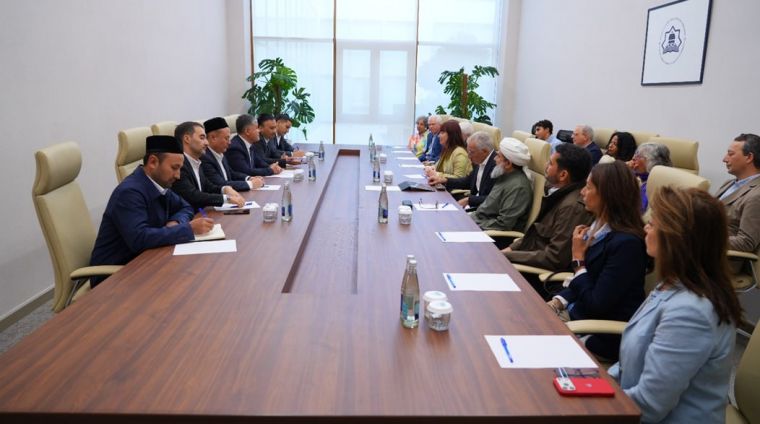
A delegation from the British Woolf Institute and the University of Cambridge visited Tashkent, Samarkand and Bukhara, where it familiarized itself with Uzbekistan’s experience in ensuring interreligious harmony and freedom of conscience, reports Dunyo IA.

According to the Embassy of Uzbekistan in the United Kingdom, meetings with representatives of the Committee on Religious Affairs and the Muslim Board were held in Tashkent. Guests were briefed on reforms in the religious sphere, measures to strengthen tolerance and interfaith harmony; and the protection of youth from radical ideas.

Delegation also visited the Center of Islamic Civilization in Tashkent, as well as historical monuments and shrines in Samarkand and Bukhara.

Woolf Institute, located in Cambridge, specializes in the study of mutual understanding among Judaism, Christianity and Islam, academic research; and the development of interreligious dialogue.

Institute’s Executive Director, Dr. Esther-Miriam Wagner, noted that Uzbekistan is the heart of Central Asia connecting the region’s Islamic heritage, and that the optimism and ambitious plans of the young country can serve as an example for Western states.

Institute Fellow Rick Sopher, former Chief Executive Officer of “Edmond de Rothschild Capital Holdings”, stated that during the trip, which included conversations with madrasah students and teachers, the delegation found no signs of religious radicalism. According to him, as a Jew, it was personally important that he heard no complaints of oppression in the synagogues of Samarkand. He called upon representatives of the United Kingdom and Europe to study Uzbekistan’s experience in ensuring unity and mutual respect.

University of Cambridge researcher Dr. Aliya Abdukadir Ali stated that she was impressed by the protection of women’s rights in Uzbekistan. She drew attention to the fact that the memory of women has been preserved for centuries at the Zangi-ata pilgrimage site in Tashkent and the Qizbibi site in Bukhara.

Visit became an important opportunity to convey Uzbekistan’s experience in the field of interreligious harmony to the international community and to develop academic, educational, cultural and humanitarian cooperation with the United Kingdom.