The President reviews the reconstructed street featuring modern solutions

On October 15, President Shavkat Mirziyoyev visited Yakkasaray district of Tashkent city to inspect the results of the reconstruction of Shota Rustaveli Street.
The development of road infrastructure and the creation of convenient traffic conditions remain among the key priorities for the capital, whose population and urban area continue to grow rapidly. Consequently, modern roads and bridges are being built across Tashkent, while existing ones are being upgraded to meet contemporary standards.

Shota Rustaveli Street, one of the city’s main arteries, connects several districts of Tashkent. To improve traffic flow, the section from Mirabad Street to Choshtepa Street, nearly 7 kilometers long, has been completely reconstructed.

The new layout includes 10 lanes: six for cars, two for public transport, and two designated for parking.
The President, accompanied by representatives of state agencies and public organizations, traveled by bus along the street, inspected the new features, and spoke with passengers about the improvements.

For the first time in Tashkent, a Bus Rapid Transit (BRT) system – dedicated lanes for public transport – has been introduced, drawing on the experience of developed countries. This innovation has significantly increased bus speed and passenger comfort.
As a result of the $19.2 million project, passenger flow rose from 2,500 to 6,000 people per hour. The road’s capacity reached 40,000 vehicles per day, while the average traffic speed increased from 23 to 30 kilometers per hour.

Most importantly, road safety improved markedly, with a significant reduction in traffic accidents.
Under the project, 21 new bus stops and 463 smart traffic lights were installed, and an intelligent transport management system was implemented. In addition, the street now features parking areas, bicycle lanes, green zones, and modern irrigation and drainage systems.
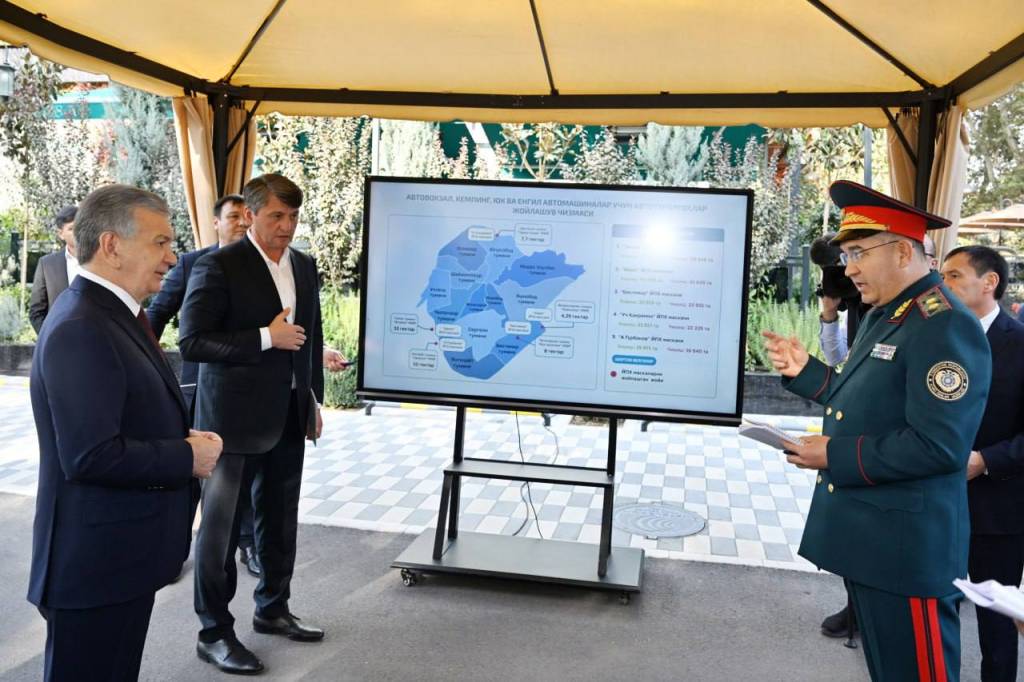
At the site, the President was also presented with projects to expand the network of dedicated bus lanes and to create new transport hubs around the capital.
“If we had not built new metro lines and purchased modern buses, traffic in Tashkent today would have become extremely difficult. That is why we are improving the roads and developing public transport to make life more convenient for people. We will continue this work in all our cities”, President Shavkat Mirziyoyev emphasized.

The President instructed responsible officials to improve public transport convenience, reduce traffic congestion, and ensure effective transport connectivity between Tashkent and New Tashkent.
The renovated Shota Rustaveli Street has not only beautified the capital but has also become a symbol of Tashkent’s transition toward a modern and intelligent transport system.
Bukhara’s seven qadis: a millennium-old school of justice and legal thought

The lives and scholarly legacy of the jurists who lived in Bukhara centuries ago and combined the principles of justice with knowledge — scholars remembered in history as “al-udat al-sab’a,” or the “Seven qadis” — are among the important sources for understanding how legal thought developed in Transoxiana. Their scholarly lineage also demonstrates the close intellectual ties that connected Bukhara with such ancient centers of learning as Ustrushana, Samarkand, and Fergana.
Throughout history, the names of certain cities have become closely associated with particular branches of learning. Bukhara is one such city. Over the centuries, hadith, tafsir, fiqh, kalam, Sufism, and other disciplines flourished there. At the same time, a rich tradition of legal thought emerged, aimed at ensuring justice in society, resolving disputes, and regulating legal relations.
Among the most prominent representatives of this tradition were the jurists widely known as “al-qudat al-sab’a” — the “seven qadis.”
The “Seven qadis” — a symbol of Bukhara’s legal thought
In Islamic civilization, the institution of the qadi was not merely an administrative office, but one of the key social institutions responsible for upholding justice and legal order in society. A qadi carried out such important duties as hearing disputes, issuing judgments in accordance with the principles of Sharia, and protecting people’s lawful rights and interests.
As Islam became more widely established in Central Asia, this institution also continued to develop. Bukhara, in particular, became known as one of the principal centers of Hanafi jurisprudence.
Historical sources mention a number of jurists who lived in Bukhara and earned widespread respect for their profound knowledge, piety, integrity, and commitment to justice. They came to be known collectively as the “Seven qadis.”
They were not seven qadis who lived at the same time, but rather a succession of distinguished scholars from different periods who engaged in jurisprudence and judicial practice and left behind a rich scholarly legacy. The fact that their graves are located in the historic Chor Bakr Bukhara complex further enhances the historical significance of this site.
For this reason, the complex is also popularly known as “Mazarat al-qudat al-sab’a” — the “Tombs of the seven qadis.”
At the beginning of the scholarly lineage: a native of Ustrushana
One of the most remarkable aspects of the history of the “Seven qadis” is that the scholarly lineage begins with the eminent jurist Abu Ja’far Ustrushani, who hailed from the region of Ustrushana.
His full name was Abu Ja’far Muhammad ibn Amr (Umar) ibn Sulayman Shu’abi (Shabi) Ustrushani. The exact date of his birth is unknown. Sources record his death as having occurred in 400/1010 or 404/1013.
Abu Ja’far Ustrushani received his early education in his native Ustrushana. He later moved to Bukhara, where he served as a qadi and became recognized as one of the leading jurists of his time.
The intellectual connections among major centers of learning such as Ustrushana, Bukhara, and Baghdad played an important role in his scholarly formation. His first teacher was his paternal uncle, Luqman ibn Sha’bi ibn Sulayman Ustrushani.
He subsequently studied under the renowned Bukhara jurist Abu Bakr Muhammad ibn Fazl Kamari Bukhari and the distinguished Baghdad-based Hanafi scholar Abu Bakr Ahmad ibn Ali Razi Jassas.
The scholarly lineage of a single scholar’s teachers alone demonstrates how extensively knowledge was exchanged across Transoxiana and the wider Islamic world during that period.
Abu Ja’far Ustrushani also left a significant scholarly legacy. A number of works on Islamic jurisprudence are attributed to him, including al-jami‘ al-kabir, al-ziyadat, and kifayat al-sha’bi.
Kifayat al-Sha‘bi, in particular, is regarded as an important source for studying the development of Hanafi jurisprudence in Transoxiana. Manuscript copies of the work preserved at the Abu Rayhan Beruni Institute of Oriental Studies of the Academy of Sciences of the Republic of Uzbekistan further attest to its scholarly value.
Abu Zayd Dabusi: a new direction in legal thought
Another prominent representative of the scholarly lineage of the “Seven qadis” was Abu Zayd Dabusi. His full name was Abu Zayd Ubayd Allah ibn Umar ibn Isa Dabusi.
Born in the village of Dabusiya, situated between Bukhara and Samarkand, the scholar served as a qadi during the Qarakhanid period. For this reason, sources also refer to him as “Qadi Zayd.”
One of the aspects for which Dabusi became particularly renowned was his scholarly work in ilm al-khilaf, a discipline devoted to the systematic analysis of differences among juristic opinions.
From the perspective of modern legal studies, the principles of comparing different legal views, examining the evidence supporting them, and reaching a reasoned conclusion on a particular issue are especially noteworthy.
His work Ta’sis al-Nazar is also of particular significance in this regard. It focuses on analyzing juristic questions on a theoretical basis and comparing differing legal opinions.
Abu Zayd Dabusi died in 430/1039 and was buried in the mausoleum of the “Seven qadis.”
One scholarly lineage — several intellectual schools
Other scholars associated with the “Seven qadis” also left an important mark on the development of legal thought in Transoxiana.
Among them, Abu Ibrahim Ismail ibn Muhammad ibn Abdullah Mustamli Bukhari occupies a distinguished place. Living from 358/968 to 434/1043, he was deeply versed in both Islamic jurisprudence and Sufism. His Sharh al-Ta’arruf is regarded as an important part of his scholarly legacy.
Badi’ Din Ahmad ibn Umar Bukhari lived in the twelfth century and became known for his work fatawa badi’ al-din.
Zahir Din Muhammad ibn Ahmad Bukhari served as both qadi and muhtasib of Bukhara. The scholar, who died in 619/1222, authored works including al-fawa’id al-zahiriyya and al-fatawa al-zahiriyya.
Ahmad ibn Amr ibn Musa Bukhari is also mentioned among the scholars who served as qadi in both Samarkand and Bukhara.
The name Zawzani appears as the seventh representative of the lineage. However, since several scholars were known by this nisba, identifying precisely which individual belonged to the “Seven qadis” requires further source-based research.
This demonstrates that certain aspects of the subject have yet to be fully explored.
From the “Seven qadis” to the “Nine qadis”
Interestingly, historical sources also provide differing accounts regarding the number of scholars included among the “Seven qadis.”
Mu’in Fuqara’s Tarikh-i Mullazada contains information about Bukhara’s “Seven qadis” cemetery and the scholars buried there.
In later studies, however, this list was expanded further, and the concept of qudat tis’a — the “Nine qadis” — also entered scholarly discussion.
The Arab researcher Subhi Jamil Khayyat, drawing on Shaykh Shah Wali Allah Dihlawi’s al-Insaf, also includes such scholars as Abu Yusr Bazdawi, Fakhr Islam Bazdawi, Abu Ma’ali Ahmad Bazdawi, and Qadikhan Uzgandi among Bukhara’s great jurists.
Each of them made a major contribution to the development of fiqh and usul al-fiqh in Transoxiana.
Thus, rather than representing a strictly fixed and closed list, the term “Seven qadis” may also be understood as a concept embodying a historical tradition that took shape within Bukhara’s legal and scholarly environment.
A scholarly world extending beyond Bukhara
The study of the history of the “Seven qadis” reveals another important reality: in the medieval period, scholarship was not confined to the boundaries of a particular city or region.
Areas such as Ustrushana, Bukhara, Samarkand, Dabusiya, and Fergana formed an interconnected intellectual and cultural space.
Abu Ja’far Ustrushani’s education in Ustrushana and subsequent activity in Bukhara; Abu Zayd Dabusi’s origins in Dabusiya and his recognition within Bukhara’s scholarly environment; and the association of such scholars as the Bazdawis and Qadikhan Uzgandi with this tradition are vivid examples of such scholarly mobility.
In this sense, the phenomenon of the “Seven qadis” is not merely about Bukhara itself. It also illustrates how legal thought took shape and developed across the wider region of Transoxiana.
The historical roots of a tradition of justice
During the First Renaissance and in the centuries that followed, Transoxiana achieved remarkable advances across various fields of learning. In this broader intellectual development, fiqh and legal thought also established strong scholarly foundations.
The scholarly lineage of the “Seven qadis” represents one important manifestation of this process.
Their lives and works gave significant attention to such issues as justice, legal order, the regulation of relations among people, and the resolution of disputes on the basis of knowledge and jurisprudence.
For this reason, studying the legacy of the “Seven qadis” is not merely an inquiry into the lives of historical figures. It also helps us understand how the scholarly foundations of legal culture and concepts of justice were formed in Central Asia.
Today, it is particularly important to conduct in-depth research into the manuscripts associated with these scholars, reconstruct their teacher–student scholarly lineages, comparatively analyze information found in different sources, and make their intellectual legacy more widely accessible to the public.
Indeed, Bukhara’s “Seven qadis” represent more than the history of a single period or a single city. They are a vivid expression of the centuries-old tradition of justice, scholarship, and legal thought that developed in Transoxiana.
Muslim Atayev, Doctor of Historical Sciences (DSc), iccu.uz
