The site is working in test mode!
16 August, 2026   |   3 Rabī‘ al-awwal, 1448

Tashkent city
Fajr
04:05
Sunrise
05:33
Dhuhr
12:27
Asr
17:19
Maghrib
19:25
Isha
20:49
Bismillah
16 August, 2026, 3 Rabī‘ al-awwal, 1448

Abdul Rahim Amin Bukhari: The Calligrapher Who Left His Mark on the Kaaba

27.10.2025   60637   6 min.
Abdul Rahim Amin Bukhari: The Calligrapher Who Left His Mark on the Kaaba

When millions of Muslims turn toward the Kaaba in Mecca for prayer, few may realize that the sweeping gold calligraphy on its iconic black cloth, the Kiswa, bears the legacy of a single artist — Abdul Rahim Amin Bukhari.

A master calligrapher from Mecca, Abdul Rahim Amin Bukhari dedicated his life to adorning Islam’s holiest site with words of divine beauty. His name, though not widely known outside Saudi Arabia, lives on in gold thread, etched into the sacred fabric that veils the Kaaba.

Abdul Rahim Amin Bukhari was born in 1917 in Mecca — a city pulsing with spiritual rhythm and Islamic tradition. As a boy surrounded by centuries-old mosques and devotional art, Bukhari was drawn to Arabic calligraphy early in life. What began as a childhood passion grew into a lifelong vocation.

At just 15, he joined the Kiswah Factory, newly established in 1927 by King Abdulaziz. This factory, devoted to producing the Kaaba’s annual covering, became the cradle of his artistic journey. Bukhari trained under the best, learning the subtle curves and disciplined elegance of classical scripts.

By the 1930s, he had risen to become chief technician, and eventually deputy director by the 1960s. His path was defined not only by artistic talent, but by humility and devotion.

Every year, the Kiswa is renewed — a majestic cloth of black silk, embroidered with Qur’anic verses in gold and silver thread. Its creation is a sacred task, and for decades, Bukhari was the pen behind its powerful script.

Specializing in the Thuluth script — a flowing, monumental style favored for religious inscriptions — Bukhari laid out every curve and flourish of the divine text. His designs set the standard, and to this day, artisans use his original layouts when crafting the Kiswa’s golden band (known as the hizam). His was not merely a job; it was an offering.

More than a technician, he was the soul of the Kiswa’s design. The gold lettering that millions of pilgrims see and touch was once inked by his hand on tracing paper, then embroidered stitch by stitch by a team he led and trained.

A Historic Commission: The Kaaba Door of 1944

One of the defining moments in Bukhari’s career came in 1944, when King Abdulaziz ordered the creation of a new door for the Kaaba. The old door, weathered by time, was to be replaced with a gilded masterpiece — and it was Bukhari who was asked to inscribe it with sacred text.

His calligraphy, rendered in bold Thuluth script, graced the new door’s copper and silver panels. The shahada (Islamic testimony of faith), the names of God, and select Qur’anic verses adorned its surface. These inscriptions were engraved into the metal by artisans, preserving Bukhari’s artistry in gleaming permanence.

This door, installed in 1947, became a symbol not just of royal generosity, but of spiritual craftsmanship. It was the first of two Kaaba doors Bukhari worked on — the second being the current door installed in 1979, which also features his calligraphy.

The Man Behind the Script

Though quiet and devoted, Bukhari’s work earned him respect at the highest levels. He wrote verses for early Saudi flags in the 1930s, crafted inscriptions for ceremonial mosque curtains, and even lettered the Rawdah curtain in Medina. King Faisal recognized his service by having Bukhari’s name woven into the Kiswa itself — a singular honor that continues to this day.

Visitors to Mecca who gaze upon the Kaaba’s belt will find his name hidden in gold — Abdul Rahim Amin. It is a subtle yet profound tribute to the man who helped shape the visual identity of Islam’s holiest structure.

A Living Legacy in Silk and Gold

Even after his passing in the late 1990s, Abdul Rahim Amin Bukhari’s calligraphy remains alive, literally sewn into the Kaaba each year. His templates are still used for the Kiswa’s verses, his scripts guide modern artisans, and his legacy continues to bridge art and worship in the most sacred way imaginable.

In the world of Islamic calligraphy, Bukhari stands as a pillar — not only for his mastery of pen and ink, but for how his work sanctified space. Every Muslim who looks at the Kaaba is unknowingly reading the words he shaped. Every stitch of gold thread reflects his lifelong devotion to making divine words beautiful.


Other posts

Pilgrimage Tourism between Uzbekistan and Indonesia enters a new phase of advancement

14.07.2026   47816   4 min.
Pilgrimage Tourism between Uzbekistan and Indonesia enters a new phase of advancement

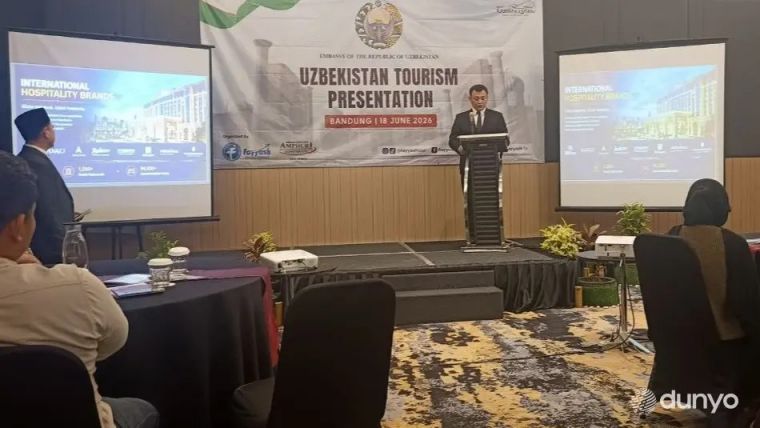
An event dedicated to the tourism potential of Uzbekistan was organized in Bandung, administrative center of West Java Province, reports Dunyo IA.

The event focused on extensively promoting the rich historical and cultural heritage, alongside the pilgrimage tourism opportunities of Uzbekistan, to the Indonesian public, while aiming to elevate bilateral tourism cooperation between the two nations to a fundamentally new level.

At the outset of the event, detailed insights were provided into the economic and demographic potential of West Java Province. With a population reaching approximately 51 million, this region stands as one of the largest and most economically advanced territories within Indonesia.

The province boasts a dynamic industrial landscape, characterized by the rapid development of the automotive, electronics, textile, chemical, logistics, and service sectors. Concurrently, West Java is widely recognized as a premier center for the Hajj and Umrah services market in Indonesia, driven by its predominantly Muslim population.

During the meeting, it was underscored that West Java is home to hundreds of licensed Hajj and Umrah tour operators, facilitating sacred journeys for hundreds of thousands of citizens annually, with the city of Bandung serving as a crucial religious and educational center. These overarching factors clearly demonstrate the vast, untapped potential for robust cooperation with Uzbekistan in the field of pilgrimage tourism.

The core segment of the event was dedicated to highlighting the paramount role of Uzbekistan's historic cities—Samarkand, Bukhara, Khiva and Termez - in Islamic civilization, showcasing the nation's sacred shrines, the rich heritage of great scholars, and the comprehensive institutional reforms executed in the tourism sector in recent years.

Concurrently, detailed information was provided regarding the modern tourism infrastructure, international standard hospitality networks, transport-logistics capacities, and the comprehensive facilities established for foreign guests.

Special video presentations highlighting the activities of the Center of Islamic Civilization in Uzbekistan and the Imam Al-Bukhari International Scientific Research Center were also showcased. The presentation generated immense interest among the participants.

Speaking at the event, the leadership of the West Java Hajj and Umrah Association emphasized the profound potential for expanding multifaceted cooperation with Uzbekistan. In their view, Uzbekistan stands as a pivotal cradle of Islamic civilization, and the sublime heritage of legendary scholars such as Imam Al-Bukhari, Imam Al-Tirmidhi and Bahauddin Naqshband carries immense spiritual and educational significance for the Indonesian Muslim community.

Furthermore, it was noted that the establishment of direct air connectivity between Jakarta and Tashkent will serve as a catalyst to elevate bilateral tourism cooperation to a fundamentally new level. Leading tour operators in West Java, including prominent agencies such as “DAGO Travel”, are expressing profound interest in the Uzbekistan market. Several operators highlighted their ongoing practice of facilitating travel for hundreds of Indonesian pilgrims to Uzbekistan annually.

The event participants emphasized that comprehensive tour packages encompassing historic cities such as Samarkand, Bukhara, and Termez hold exceptional appeal for Indonesian travellers.

At the conclusion of the event, the participants held detailed discussions on the procedures for traveling to Uzbekistan, visa regimes, air connectivity, hospitality infrastructure, and frameworks for close cooperation with local tour operators. This presentation served as a significant milestone in further expanding bilateral cooperation in the field of pilgrimage tourism, strengthening cultural and humanitarian ties, and driving a substantial increase in the influx of Indonesian tourists to the Republic.