The site is working in test mode!
15 August, 2026   |   2 Rabī‘ al-awwal, 1448

Tashkent city
Fajr
04:04
Sunrise
05:32
Dhuhr
12:28
Asr
17:20
Maghrib
19:27
Isha
20:52
Bismillah
15 August, 2026, 2 Rabī‘ al-awwal, 1448

Gandhi Praised Caliphs Abu Bakar and Umar as Role Models in His 1937 Newspaper

28.10.2025   113255   2 min.
Gandhi Praised Caliphs Abu Bakar and Umar as Role Models in His 1937 Newspaper

In the July 27, 1937 issue of his weekly journal Harijan, Mahatma Gandhi praised Islamic Caliphs Abu Bakar (RA) and Umar Farooq (RA) as examples of humble and responsible leadership.

In a rare reference to Islamic history, Mahatma Gandhi praised Caliphs Abu Bakar and Umar Farooq as examples of simple and honest leadership.

He made this statement in the July 27, 1937 issue of his weekly journal, Harijan, offering advice to Indian National Congress leaders as they began to hold public office.

In that issue of Harijan, Gandhi wrote:

“I cannot give you the reference of Ram Chandar or Krishna, because they were not considered as historical figures. I cannot help it but to present to you the names of (Hazrat) Abu Bakar (RA) and (Hazrat) Umar Farooq (RA). They were leaders of a vast Empire, yet they lived a life of austerity.” Harijan – Dated: 27.07.1937

This statement came during an important moment in India’s history. In 1937, the Indian National Congress formed governments in several provinces for the first time under British rule, following elections held under the Government of India Act, 1935.

Gandhi, always cautious about the moral health of leaders, urged Congress members not to be consumed by power or luxury. He used the examples of Caliphs Abu Bakar and Umar Farooq to remind them that true leaders live simply and serve the people.

Harijan was Gandhi’s weekly newspaper, launched in 1933 to support his social reform campaigns — especially against untouchability. The journal regularly featured Gandhi’s views on religion, politics, and ethics.

The journal was published in English, along with versions in Hindi (Harijan Sewak) and Gujarati (Harijanbandhu), and ran until 1955.

This was not the only time Gandhi showed appreciation for Islamic values. He often quoted the Quran, Prophet Muhammad (PBUH), and his companions in speeches and writings.


Gandhi Praised Caliphs Abu Bakar and Umar as Role Models in His 1937 Newspaper
Other posts

Egyptian media highlight the Imam al-Bukhari Complex

22.07.2026   55738   2 min.
Egyptian media highlight the Imam al-Bukhari Complex

News portal “see.news” and the leading Egyptian newspaper “Al-Ahram” have published articles about the upcoming International Sister Cities Forum in Samarkand and the Imam al-Bukhari Complex near Samarkand, reports Dunyo IA correspondent.

According to the “see.news” portal, International Sister Cities Forum will be held in Samarkand on July 24-25th, 2026, aimed at expanding Uzbekistan's international cooperation, strengthening partnerships between cities, and developing public diplomacy. The forum's program will include an international scientific and practical conference on urban cooperation, panel sessions and roundtables, ceremonies for signing memorandums and agreements between sister cities, presentations on public diplomacy and interregional interaction, cultural and educational events for foreign delegations, study tours of Samarkand's historical monuments, as well as exhibitions showcasing the investment, tourism and cultural potential of Uzbekistan's regions.

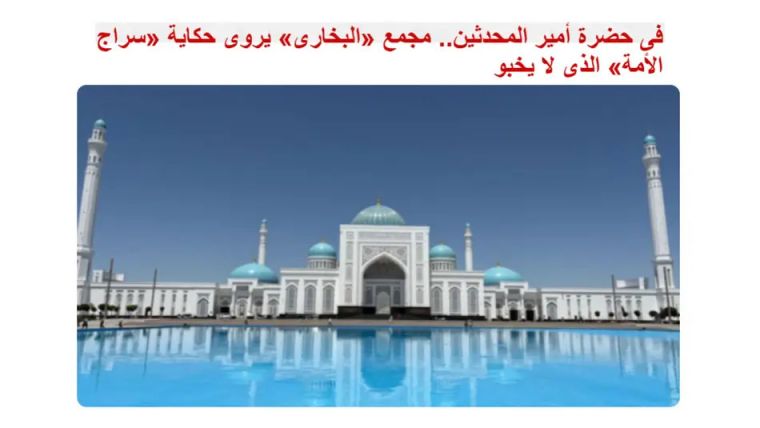
 “Al-Ahram” correspondent, Muhammad Abdulsalam Sabrin, dedicated a report to the Imam al-Bukhari Complex near Samarkand, having visited it as part of the international scientific conference “The Mosque of the Authentic Musnad of Imam Bukhari: The Book of the Nation”. The author describes the complex as an integrated scientific and spiritual city spanning an area of about 450,000 square meters, featuring a mosque with four 75-meter minarets, an interactive museum consisting of nine pavilions with rare manuscripts and maps of Imam al-Bukhari’s travels, as well as an infrastructure designed to receive delegations from across the Muslim world. According to the journalist, the complex's capacity after reconstruction has increased from 12,000 to nearly 65,000 visitors per day and he described the site not merely as an architectural monument, but as a message of tolerance and the values of coexistence among peoples.