33,000 Saplings Planted Around Mosques

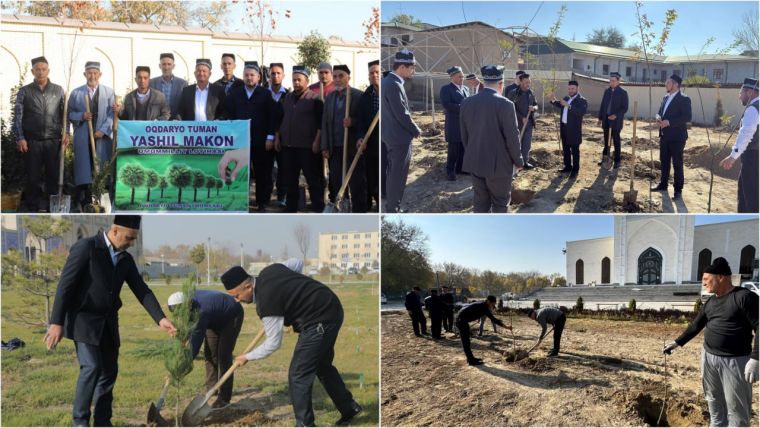
As part of the nationwide “Yashil makon” launched at the initiative of our esteemed President Shavkat Mirziyoyev, fruit and ornamental tree saplings were planted in the territories of the representative offices, mosques, and surrounding areas affiliated with the Muslim Board of Uzbekistan.
Under the leadership of chief imams and with the participation of local community activists, a total of 32,670 saplings were planted across 2,147 mosque sites in the Republic of Karakalpakstan, the city of Tashkent, and the regions. Of these, 22,775 are ornamental and 9,632 are fruit-bearing trees.
Muslim Board of Uzbekistan
Press Service




MFA holds talks on expanding tourist flows from Indonesia, Malaysia, and Singapore to Uzbekistan

A meeting was held yesterday at the Ministry of Foreign Affairs to discuss the implementation of the decree of the Head of our state “On Measures to Further Develop Domestic and Pilgrimage Tourism in the Republic of Uzbekistan” dated February 9, 2021, and the resolution of the Cabinet of Ministers “On Additional Measures to Implement the “Umrah Plus” Pilgrimage Tourism Program dated January 9, 2026, as well as to expanding tourist flows from Indonesia, Malaysia, and Singapore to Uzbekistan, reports Dunyo IA.
According to the MFA, the meeting, organized in a hybrid format, was attended by representatives of the Tourism Committee of Uzbekistan, the Committee on Religious Affairs, the Technical Regulation Agency, the khokimiyats of Bukhara and Samarkand regions and Tashkent city, JSC Uzbekistan Airways, JSC Uzbekistan Airports, domestic airlines, the Uzbekistan–Malaysia–Indonesia Travel Association, the Association of Umrah Pilgrimage Travel Agencies, as well as nearly 40 representatives of tourism companies.
Participants discussed in detail transport and logistics, service quality, and promotional measures aimed at increasing tourist arrivals to Uzbekistan from Southeast Asian countries. In particular, they considered increasing the number of flights from Malaysia, launching direct flights from Indonesia and Singapore, intensifying promotional activities for pilgrimage tourism under the “Umrah Plus” program, aligning infrastructure for foreign pilgrims with international halal standards, and strengthening coordination with tourism companies operating in this field.
The event was held in an open dialogue format based on the “problem–proposal–solution” approach, providing participants with an opportunity to exchange constructive views on existing challenges and opportunities in the sector.
