Pilgrimage Tourism between Uzbekistan and Indonesia enters a new phase of advancement
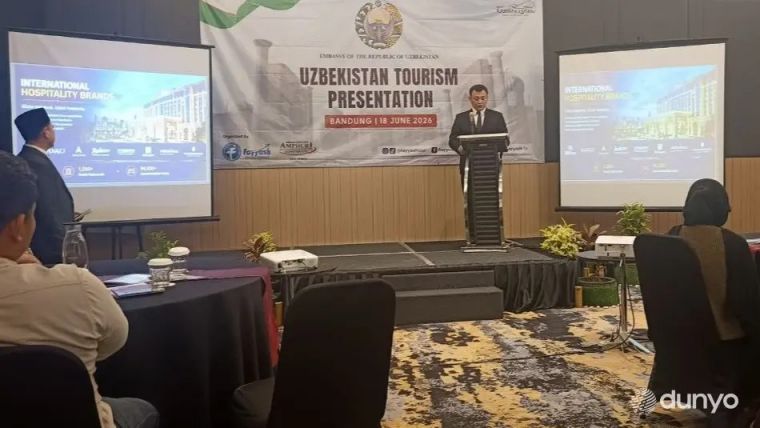
An event dedicated to the tourism potential of Uzbekistan was organized in Bandung, administrative center of West Java Province, reports Dunyo IA.
The event focused on extensively promoting the rich historical and cultural heritage, alongside the pilgrimage tourism opportunities of Uzbekistan, to the Indonesian public, while aiming to elevate bilateral tourism cooperation between the two nations to a fundamentally new level.
At the outset of the event, detailed insights were provided into the economic and demographic potential of West Java Province. With a population reaching approximately 51 million, this region stands as one of the largest and most economically advanced territories within Indonesia.
The province boasts a dynamic industrial landscape, characterized by the rapid development of the automotive, electronics, textile, chemical, logistics, and service sectors. Concurrently, West Java is widely recognized as a premier center for the Hajj and Umrah services market in Indonesia, driven by its predominantly Muslim population.
During the meeting, it was underscored that West Java is home to hundreds of licensed Hajj and Umrah tour operators, facilitating sacred journeys for hundreds of thousands of citizens annually, with the city of Bandung serving as a crucial religious and educational center. These overarching factors clearly demonstrate the vast, untapped potential for robust cooperation with Uzbekistan in the field of pilgrimage tourism.
The core segment of the event was dedicated to highlighting the paramount role of Uzbekistan's historic cities—Samarkand, Bukhara, Khiva and Termez - in Islamic civilization, showcasing the nation's sacred shrines, the rich heritage of great scholars, and the comprehensive institutional reforms executed in the tourism sector in recent years.
Concurrently, detailed information was provided regarding the modern tourism infrastructure, international standard hospitality networks, transport-logistics capacities, and the comprehensive facilities established for foreign guests.
Special video presentations highlighting the activities of the Center of Islamic Civilization in Uzbekistan and the Imam Al-Bukhari International Scientific Research Center were also showcased. The presentation generated immense interest among the participants.
Speaking at the event, the leadership of the West Java Hajj and Umrah Association emphasized the profound potential for expanding multifaceted cooperation with Uzbekistan. In their view, Uzbekistan stands as a pivotal cradle of Islamic civilization, and the sublime heritage of legendary scholars such as Imam Al-Bukhari, Imam Al-Tirmidhi and Bahauddin Naqshband carries immense spiritual and educational significance for the Indonesian Muslim community.
Furthermore, it was noted that the establishment of direct air connectivity between Jakarta and Tashkent will serve as a catalyst to elevate bilateral tourism cooperation to a fundamentally new level. Leading tour operators in West Java, including prominent agencies such as “DAGO Travel”, are expressing profound interest in the Uzbekistan market. Several operators highlighted their ongoing practice of facilitating travel for hundreds of Indonesian pilgrims to Uzbekistan annually.
The event participants emphasized that comprehensive tour packages encompassing historic cities such as Samarkand, Bukhara, and Termez hold exceptional appeal for Indonesian travellers.
At the conclusion of the event, the participants held detailed discussions on the procedures for traveling to Uzbekistan, visa regimes, air connectivity, hospitality infrastructure, and frameworks for close cooperation with local tour operators. This presentation served as a significant milestone in further expanding bilateral cooperation in the field of pilgrimage tourism, strengthening cultural and humanitarian ties, and driving a substantial increase in the influx of Indonesian tourists to the Republic.
Journalists from nearly 50 countries will visit the new Imam Bukhari Complex and Samarkand’s major historical monuments

Participants of the International Media Forum “Islamic Civilization: New Perspective — New Discoveries” will travel to Samarkand on August 27. They will visit the newly built Imam Bukhari Memorial Complex, the Imam Bukhari International Scientific Research Center, and the Imam Bukhari Innovation Museum. In the afternoon, a special program will be organized for the participants to explore the city’s historical and cultural heritage sites, including monuments inscribed on the UNESCO World Heritage List.
The memorial complex is located in the Payariq district of Samarkand Region, at the burial site of the great hadith scholar and theologian Muhammad Bukhari (810–870). He was the compiler of “Sahih al-Bukhari,” which is regarded as one of the most authoritative collections of hadith in Sunni Islam.
Following extensive reconstruction, the complex reopened to visitors in the spring of 2026. It covers a total area of 45 hectares. The complex features a mosque with a capacity of 10,000 worshippers, administrative and service buildings, a colonnaded terrace with 154 columns, 14 blue domes, and four minarets rising to a height of 75 meters. Following the reconstruction, the complex’s daily visitor capacity increased from 12,000 to 65,000.
One of the central components of the complex is the new Imam Bukhari Innovation Museum, comprising nine pavilions. The exhibition is dedicated to the scholar’s life, the history of hadith studies, and his scholarly legacy. The museum also presents information about the prophets mentioned in the Qur’an, the life of Prophet Muhammad (peace be upon him) in Mecca and Medina, and the history of the formation of written hadith collections.
The Imam Bukhari International Scientific Research Center also operates near the complex. The Center is engaged in studying the Islamic scholarly and manuscript heritage, including the works of medieval Central Asian scholars, conducting academic research and preparing translations, as well as promoting international scholarly exchange.
Following their visit to the complex, forum participants will explore historic Samarkand. The city’s major architectural monuments include Registan, the Bibi-Khanum Mosque, the Shah-i-Zinda complex, and the Gur-e-Amir Mausoleum. UNESCO recognizes these four sites as key monuments of the historic city inscribed on the World Heritage List in 2001 under the title “Samarkand — Crossroad of Cultures.”
The Samarkand leg will form part of the program of the International Media Forum “Islamic Civilization: New Perspective — New Discoveries,” which will take place in Tashkent and Samarkand from August 24 to 28.
