“Kyiv Diplomatic”: Bukhara strengthens its position as an International Cultural Centre
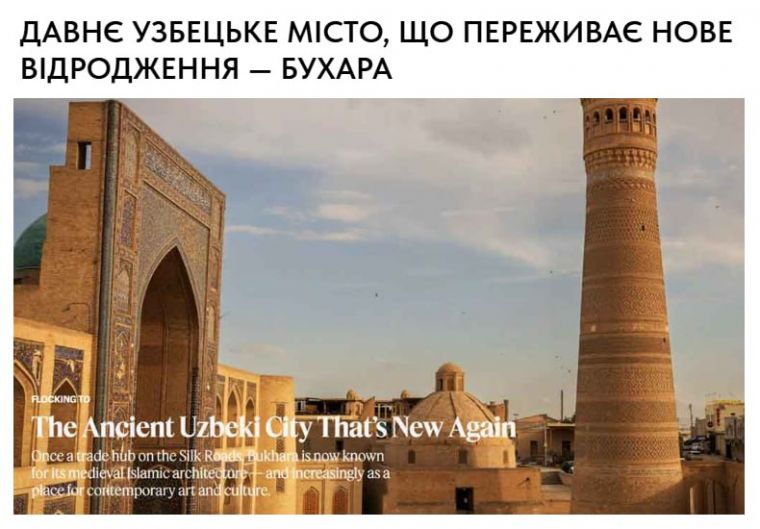
Today ancient Bukhara is once again strengthening its position as an international cultural centre and experiencing a new stage of cultural and tourism development, reports Dunyo IA correspondent, citing with reference to the Ukrainian magazine “Kyiv Diplomatic”.
Publication notes that the American newspaper “The New York Times” published an article dedicated to Bukhara, one of the oldest cities in Uzbekistan. For more than a thousand years, Bukhara remained one of the most important centres of the Great Silk Road, connecting the East and the West. Trade routes passed through the city, along which jewellery, textiles, porcelain, and other valuable goods were transported. From the 8th to the 13th centuries, Bukhara became one of the largest intellectual and cultural centres of the Islamic world, where outstanding scholars, architects, mathematicians and artists worked.
Authors of the publication pay particular attention to the city’s rich historical and architectural heritage. Bukhara has preserved the ancient Ark Fortress, mausoleums, madrasas, mosques with distinctive turquoise domes, and other landmarks, many of which are included in the UNESCO World Heritage List. More than 140 sites of the historic center are located within walking distance of one another, making the city one of the best-preserved historical complexes in Central Asia.
According to the publication, today Bukhara is once again strengthening its position as an international cultural center. One of the most important events was the first Bukhara Biennial of Contemporary Art, held in the autumn of last year. As part of the project, artists from Uzbekistan and other countries created works specifically for the city’s historic spaces, collaborated with local artisans and participated in joint cultural initiatives.
As noted in the publication, the organization of the Biennial contributed not only to the promotion of cultural heritage but also to the development of tourism infrastructure. New hotels, restaurants, cultural spaces and shops are opening in Bukhara, catering to the growing interest of international travellers.
“The New York Times” also presented its own city guide, recommending that tourists visit historical landmarks, including the Sitorai Mokhi-Khosa Palace, Chor-Bakr Memorial Complex, Baland Mosque and Khoja Zayniddin Sufi Complex.

“EM Insights”: Media Forum in Tashkent calls on the Media to preserve cultural memory
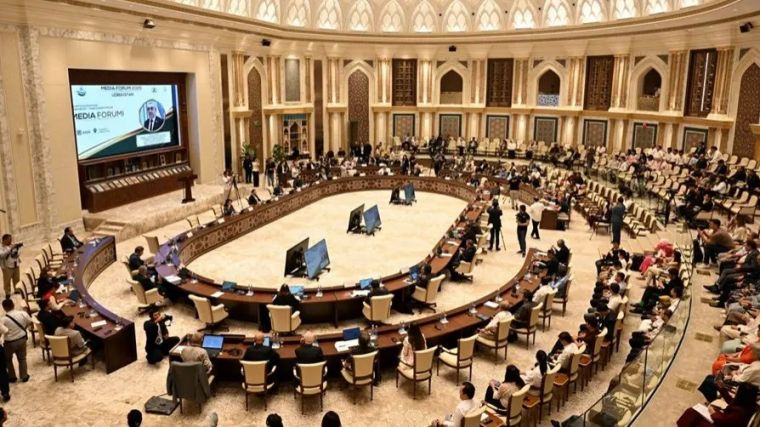
International Media Forum, organized by the Center for Islamic Civilization in Uzbekistan, brought together representatives of nearly 300 media outlets from 50 countries, reports Dunyo IA correspondent, citing with the British portal “EM Insights”.
Participants discussed the impact of digital platforms and artificial intelligence on journalism, as well as the promotion of the historical and intellectual heritage of Islamic civilization.
Mohammad Osman, Managing Editor of The Peninsula newspaper, described the forum as “timely and vital”, emphasizing the importance of fact-checking and a responsible approach to information.
Editor of the National Information Agency of Uzbekistan Utkir Alimov noted the country’s growing role as a “crossroads of civilizations” and called for the development of international media projects and professional exchanges. Forum was organized by the Center for Islamic Civilization in Uzbekistan. Participants discussed the impact of digital platforms, artificial intelligence and modern media formats on the dissemination of historical knowledge and the shaping of perceptions of Islamic civilization.
Mohammad Osman, Managing Editor of Qatar’s “The Peninsula” newspaper, described the forum as “timely and vital”. According to him, Imam al-Bukhari’s methods of verifying the authenticity of hadiths remain relevant in the digital age, when journalists face disinformation and AI-generated content.
Utkir Alimov, Editor of the National Information Agency of Uzbekistan (UzA), noted that the participation of representatives from nearly 300 media outlets across 50 countries demonstrates the growing role of Uzbekistan as a "crossroads of civilizations.
“In an era of instantaneous news dissemination, journalism must do more than just inform. It is called upon to preserve and transmit our shared cultural memory”, he stated.
Necessity of developing international cooperation, joint media projects, documentary films and professional exchanges to popularize the historical and intellectual heritage of Central Asia was also emphasized.
- «
- »