International Mugam Center in Baku hosted an international conference titled “Uzbekistan and Azerbaijan: Common Historical Heritage, Islamic Civilization and Modern Scientific Cooperation”, reports Dunyo IA.
Participants focused on studying the historical and spiritual ties between the two countries, popularizing the heritage of prominent scholars and thinkers, and expanding research, cultural, and humanitarian cooperation.
Event was attended by the Ambassador of Uzbekistan Bahrom Ashrafkhanov, President of the Azerbaijan National Academy of Sciences Isa Habibbeyli, Director of the Center for Islamic Civilization in Uzbekistan Firdavs Abdukhalikov, representatives of the Muslim Board of Uzbekistan, heads of museums, scholars, as well as culture and art figures.
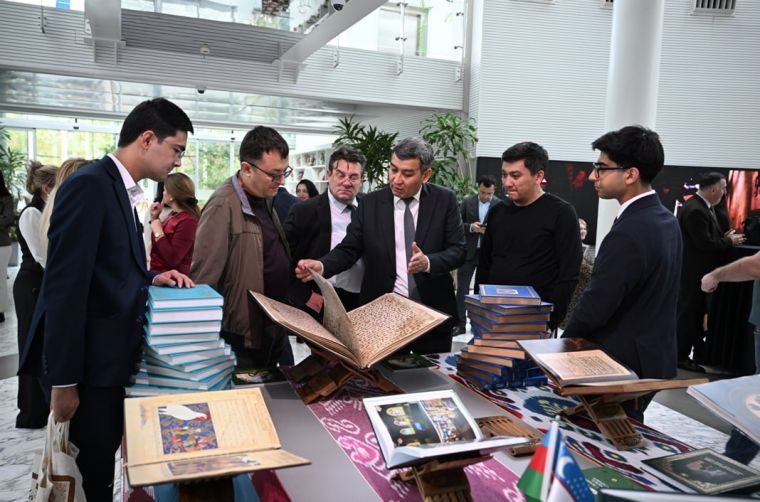
Conference program opened with video materials dedicated to Uzbek-Azerbaijani relations and the activities of the Center for Islamic Civilization in Uzbekistan. An exhibition of the Center's publications was also organized for the guests, showcasing the country's historical, scientific and spiritual heritage.
Addressing the participants, Ambassador of Uzbekistan Bahrom Ashrafkhanov, emphasized the significance of century-old ties, shared values, and the strategic partnership between the two states.
According to the diplomat, the Great Silk Road has for centuries facilitated the exchange of knowledge, ideas, and cultural achievements. A special place in this process is occupied by the heritage of Muhammad al-Khwarizmi, Abu Rayhan Beruni, Ibn Sina, Mirzo Ulugbek, Nizami Ganjavi, Imadaddin Nasimi, and Muhammad Fuzuli, which has become part of the common intellectual treasury of the peoples of the region.
Today, we are consistently strengthening cooperation between scientific institutions, uniting the efforts of scholars and researchers. Our common interests encompass the study of historical heritage, the implementation of programs for young specialists, and the development of joint projects. The current conference creates additional opportunities for achieving these goals.
Necessary conditions have already been established to develop such interaction. Diplomatic channels have been opened, scientific exhibitions are operating, and opportunities for showcasing cultural heritage are expanding. I am confident that the Center for Islamic Civilization will become a unique platform for meaningful dialogue and will serve to further strengthen scientific, cultural, and humanitarian ties between Baku and Tashkent, the Ambassador noted.
Director of the Center for Islamic Civilization in Uzbekistan Firdavs Abdukhalikov, presented the core activities of the institution, highlighting its educational mission, the study of ancestral heritage, and the transmission of historical knowledge to future generations.
The ties between our peoples originated long before the spread of Islam. In the subsequent centuries, the Islamic civilization infused them with new substance, facilitating the development of scientific and cultural exchange. Scholars adopted each other's experiences, manuscripts circulated between countries and scientific ideas were further advanced in various intellectual centers.
This is evidenced by the scientific traditions of Ibn Sina and his Azerbaijani disciple Bahmanyar, the activities of Nasir al-Din al-Tusi in Maragheh, and the astronomical school of Mirzo Ulugbek in Samarkand.
A special place in the history of cultural interaction is occupied by literary heritage. “Khamsa” of Nizami Ganjavi inspired Alisher Navoi to create his own masterpiece in the Turkic language. The works of Navoi, in turn, exerted a notable influence on the Azerbaijani poet Kishvari. It is symbolic that in one of the manuscripts preserved in Tashkent, the works of Navoi and Fuzuli are compiled under a single binding. Two great poets belonging to a shared literary tradition are presented in one book.
Today, this historical closeness finds its practical continuation through the mutual trust and joint initiatives of Presidents Shavkat Mirziyoyev and Ilham Aliyev. A vivid example of this was the opening of the Mirzo Ulugbek School in the city of Fuzuli by the heads of the two states.
This project organically blends history and modernity. The city bearing the name of the great poet, the school named after the outstanding scholar, and the children receiving their education there epitomize the continuity of generations. The heritage of our ancestors continues to inspire youth to acquire knowledge and achieve new milestones, Firdavs Abdukhalikov emphasized.
Special attention was paid by the participants to the musical traditions of Uzbekistan and Azerbaijan. During the discussions, the historical and cultural commonality of the Azerbaijani mugam and the Uzbek maqom was highlighted, reflecting the centuries-old interaction between national performing arts schools and the spiritual closeness of the two peoples.
First Deputy Chairman of the Muslim Board of Uzbekistan Homidjon Ishmatbekov, elaborated on the role of the religious and educational heritage in strengthening bilateral relations.
Modern cooperation between Uzbekistan and Azerbaijan opens up additional prospects for interaction between Central Asia and the Caucasus. Its solid foundation is constituted by the historical commonality, cultural traditions, and spiritual values that have been formed over centuries.
Of particular significance in this context is the heritage of Ahmad Yasawi, Bahauddin Naqshband and Seyid Yahya Bakuvi. Their teachings bear witness to the profound religious and spiritual ties between the Turkic peoples. The ideas of moral perfection, humanism and spiritual development instilled by the great thinkers remain relevant in contemporary society.
Muslim Board of Uzbekistan is interested in expanding interaction with religious institutions and Islamic scholars of Azerbaijan, implementing joint educational initiatives and strengthening spiritual cooperation, Homidjon Ishmatbekov stated.
A significant outcome of the conference was the signing of a memorandum of cooperation between the Center for Islamic Civilization in Uzbekistan and the Azerbaijan National Academy of Sciences.
Document provides for the development of partnership ties between scientific institutions, the conducting of joint research, and the expansion of interaction in the field of studying and preserving historical and cultural heritage.
President of the Azerbaijan National Academy of Sciences Isa Habibbeyli, noted that the cooperation between the scientific communities of the two countries rests on profound historical traditions and is acquiring new substance thanks to modern joint initiatives.
Our peoples are united by a centuries-old history spanning various eras and the periods of rule of the Temurid, Safavid, Khwarazmian and other states of the region. Over the centuries, common cultural traditions were formed, scientific schools developed, and spiritual ties were strengthened.
Today, this heritage serves as the foundation for implementing joint projects, hosting scientific meetings, and organizing international conferences. Regular contacts among researchers, reciprocal visits and professional dialogue bear witness to the progressive development of academic cooperation.
Center for Islamic Civilization in Uzbekistan represents a large-scale project, the significance of which extends far beyond the borders of a single country and encompasses the entire Turkic world. Special attention is drawn to the modern approach to presenting historical heritage, which provides for the use of advanced technologies and formats oriented toward the younger generation.
“I am convinced that the current conference will provide an additional impetus to scientific ties, expand opportunities for joint research activities and contribute to the preservation of our common cultural heritage”, Isa Habibbeyli emphasized.
Conference concluded with a concert program featuring performers of Azerbaijani mugam and Uzbek maqom. The musicians' performances demonstrated the richness of national performing traditions and their shared cultural roots.
International Conference in Baku served as a platform for meaningful scientific dialogue and the development of new areas of cooperation. The agreements reached create a foundation for further studying the common historical heritage, advancing academic exchanges and implementing joint cultural and educational projects.



 Iman
 Prayer
 Fasting
 Zakat
 Haj
 Qur`an
 Lessons of Islam
 Contact