Russian Media: Uzbekistan presents initiatives at UNESCO to promote the study of the Heritage of Mawarannahr
14.10.2026
167502
2 min.
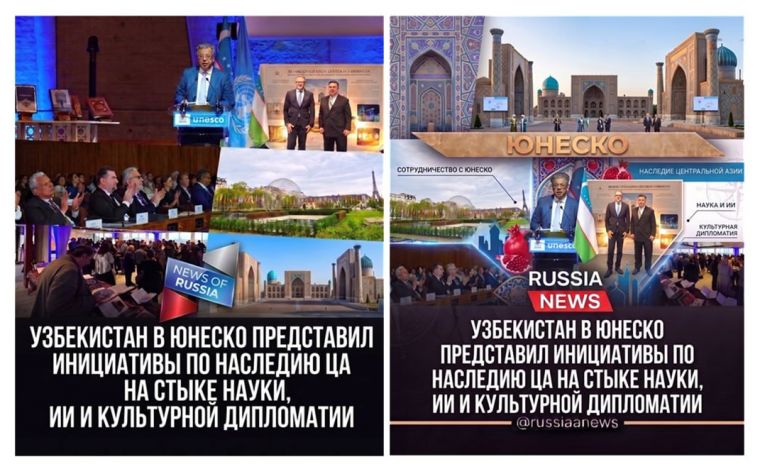
Russian online media outlets have published articles covering the international conference “Islamic Civilization: The Great Spiritual and Scientific Heritage of Mawarannahr and the Horizons of Enlightenment”, held at UNESCO headquarters in Paris, reports Dunyo IA.
As “News of Russia” reports, the conference brought together more than 300 participants, including diplomats and representatives of international organizations, universities and research centers. Publication highlighted the address by Firdavs Abdukhalikov, Director of the Centre of Islamic Civilization in Uzbekistan and Chairman of the World Society for the Study, Preservation and Popularization of the Cultural Heritage of Uzbekistan (WOSCU). He outlined how President Shavkat Mirziyoyev’s initiatives are bringing the region’s spiritual heritage to a wider international audience by linking humanities research, digital technologies, artificial intelligence and cultural diplomacy. Publication also highlighted the role of Russia, noting that academic institutions in the two countries have been engaged in the joint study of Oriental manuscripts for decades.
According to “Russia News”, conference formed part of broader efforts to advance the initiative put forward by the President of Uzbekistan at the 80th session of the United Nations General Assembly in September 2025. The initiative aims to expand the study of Central Asia’s heritage and strengthen cooperation among countries, research institutions and international organizations.
Both publications quote Firdavs Abdukhalikov as emphasizing that events held at UNESCO and United Nations venues represent successive stages of a broader effort to make Central Asia’s heritage more accessible to the international community and create new opportunities for manuscript digitization, the application of artificial intelligence and the training of a new generation of scholars. Publications identify five key areas of cooperation: a digital platform for historical sources, the use of artificial intelligence to study manuscripts, an international scientific consortium, support for young researchers and cultural diplomacy.
Centre of Islamic Civilization in Uzbekistan, which opened in Tashkent in March 2026, is cited as a practical embodiment of this approach. Among its key exhibits is the Uthman Quran, included in UNESCO’s “Memory of the World” Register.
SHARE INFORMATION ON SOCIAL NETWORKS



 Iman
 Prayer
 Fasting
 Zakat
 Haj
 Qur`an
 Lessons of Islam
 Contact