Researchers from Uzbekistan visit French libraries.
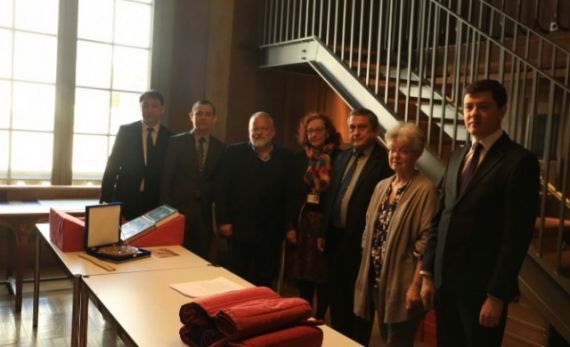
A group of scholars in oriental and Islamic studies visited National Library of France and the Languages and Civilization Library of France in Paris in order to introduce French cultural circles with a wide range of developments in Uzbekistan reports UzA.
The main purpose of the visit was to get acquainted with the activity of libraries in France, preservation of rare manuscripts of our ancestors and establish partnership among the institutions. It is worth noting that Languages and Civilization Library is unique in France which has a department for Central Asian documents. The library has manuscripts, rare books and research works in more than 350 languages from around 180 countries. More than hundred students, researchers and guests visit the library daily.
The sides agreed on exchange of specialists and presentation of books published in Uzbekistan which was held the same day at the library where 15 books published by Imam Bukhari International scientific-research center was shown. The Uzbek delegation felt proud to hear Mr. Benjamin Gishar’s acknowledgment that Uzbekistan stood out among Central Asian countries with its rich scientific potential. He also mentioned that Imam Bukhari’s XVII century “Sahihi Bukhari”, Ibn Sina’s “The Laws of Treatment”, Mirzo Ulugbek’s “Ziji jadidi Kuragoni”, Mahmud Zamahshariy’s “Mukaddamatul adab” were among the true treasures of the libarary and in that respect French part was willing to cooperate with Uzbek specialists to study the manuscripts.
During the talks held in the National Library of France which has 31 million books it was concluded that specialists from Imam Bukhari International Research Center and The Center for Islamic Civilization in Uzbekistan would be given access to the manuscripts in order to get copies from VIII-XI centuries Qur’an, Imam Bukhari, Khorezmi, Beruniy and Fergani’s works in Arabic and Latin languages. Within the framework of “Cultural Employee” program two practitioners from Uzbekistan would be admitted for manuscript digitalization specialization.
Press Service,
Muslim Board of Uzbekistan
Journalists from nearly 50 countries will visit the new Imam Bukhari Complex and Samarkand’s major historical monuments

Participants of the International Media Forum “Islamic Civilization: New Perspective — New Discoveries” will travel to Samarkand on August 27. They will visit the newly built Imam Bukhari Memorial Complex, the Imam Bukhari International Scientific Research Center, and the Imam Bukhari Innovation Museum. In the afternoon, a special program will be organized for the participants to explore the city’s historical and cultural heritage sites, including monuments inscribed on the UNESCO World Heritage List.
The memorial complex is located in the Payariq district of Samarkand Region, at the burial site of the great hadith scholar and theologian Muhammad Bukhari (810–870). He was the compiler of “Sahih al-Bukhari,” which is regarded as one of the most authoritative collections of hadith in Sunni Islam.
Following extensive reconstruction, the complex reopened to visitors in the spring of 2026. It covers a total area of 45 hectares. The complex features a mosque with a capacity of 10,000 worshippers, administrative and service buildings, a colonnaded terrace with 154 columns, 14 blue domes, and four minarets rising to a height of 75 meters. Following the reconstruction, the complex’s daily visitor capacity increased from 12,000 to 65,000.
One of the central components of the complex is the new Imam Bukhari Innovation Museum, comprising nine pavilions. The exhibition is dedicated to the scholar’s life, the history of hadith studies, and his scholarly legacy. The museum also presents information about the prophets mentioned in the Qur’an, the life of Prophet Muhammad (peace be upon him) in Mecca and Medina, and the history of the formation of written hadith collections.
The Imam Bukhari International Scientific Research Center also operates near the complex. The Center is engaged in studying the Islamic scholarly and manuscript heritage, including the works of medieval Central Asian scholars, conducting academic research and preparing translations, as well as promoting international scholarly exchange.
Following their visit to the complex, forum participants will explore historic Samarkand. The city’s major architectural monuments include Registan, the Bibi-Khanum Mosque, the Shah-i-Zinda complex, and the Gur-e-Amir Mausoleum. UNESCO recognizes these four sites as key monuments of the historic city inscribed on the World Heritage List in 2001 under the title “Samarkand — Crossroad of Cultures.”
The Samarkand leg will form part of the program of the International Media Forum “Islamic Civilization: New Perspective — New Discoveries,” which will take place in Tashkent and Samarkand from August 24 to 28.