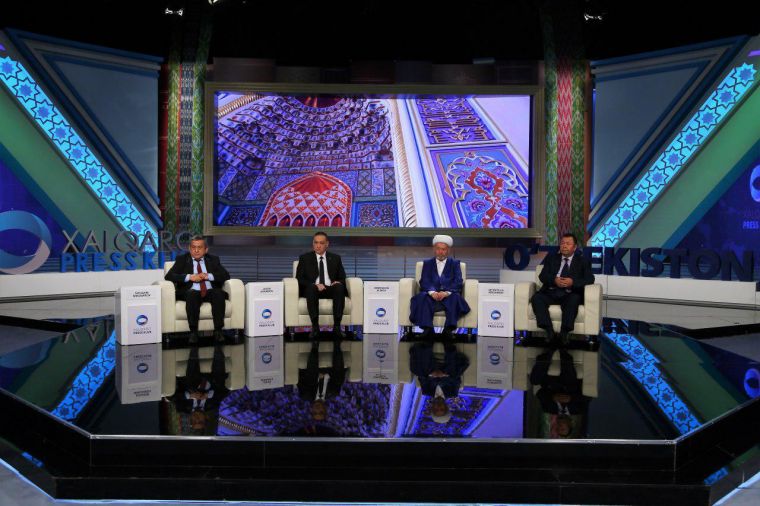
These days as in all other spheres great number of works are carried out and positive developments are being observed in religious-enlightenment part as well. As a logical continuation of all the efforts to make the sphere better on April 16, 2018 President Sh. Mirziyoyev adopted the decree “On rational improvement of religious-enlightenment sphere” which has become a discussion object at International Press Club’s last session. It has lately become evident that one of the main principles and guarantees of establishing and preserving social stability and peace is achieved through education young generation based on the priceless historical heritage of our ancestors who preserved national and religious values, contributed to the world sciences and demonstrated multicultural solidarity and religious tolerance.
Only for the last one and a half year the following institutions were founded: Imam Bukhari International scientific-research center, Imam Termiziy International scientific-research center, Center for Islamic civilization, “Mir Arab” Higher Madrasah in Bukhara. Beside, Republican Schools of Kalam, Khadith, Aqeedah have also started their activity. In addition it is worth mentioning that quota for student admission has doubled. In this regard it should be noted that on September 13, 2017 Cabinet Ministers of Uzbekistan issued a decree on establishing “Khidoyat sari (Towards true path)” and “Ziyo media center”
The main and important standing column of the decree on rational improvement of religious-enlightenment sphere is “struggle against any form of violence by means of enlightenment and education of true and pure religious values, promoting the study of historical, religious and national values, promoting peace, religious tolerance and multicultural solidarity. It was noted that the roles and responsibilities of specialists working in religious sphere were very high in preserving peace and stability. For this reason training and preparing specialists is crucial. Thus Islamic Academy of Uzbekistan and Tashkent Islamic University were joined and reorganized into International Islamic Academy of Uzbekistan. The Decree also foresaw the establishment of Hadith school, “Waqf Charity Fund” under Muslim Board of Uzbekistan, “Ziyo (The Light)” Media center would be raised under International Islamic Academy of Uzbekistan, etc.
A number of leading mass media representatives actively took part in the event with various interesting questions.
Press Service,
Muslim Board of Uzbekistan
The Central Bank expects to establish at least 10 full-fledged Islamic banks by 2030. Also, “Islamic windows” — branches providing Sharia financial services — will appear in three state banks. The Central Bank considers Islamic finance as a tool for withdrawing funds from the shadow economy.
Why is this important
According to a UNDP survey, 68% of Uzbekistan’s population does not want to use traditional banking services due to religious beliefs. Launching Islamic banks will expand financial inclusion, increase bank assets, and reduce the share of the shadow economy. This is the largest transformation of the financial system since independence.
What happened
Draft law
The document introduces the concepts of “Islamic banking activity”, “Islamic financial operations”, “investment deposit”, and others. A separate license is provided for Islamic banks. Classical banks will be able to organize “Islamic windows” if they have a license.
Islamic products: Murabaha (deferred trade financing), Mudaraba (investment partnership), Mushoraka (joint venture), Wakala (agency financing), Salam (prepayment of goods).
Features of regulation
Assessment of demand
The Deputy Chairman of the Central Bank clarified: when we talk about 50-60% of the population preferring Islamic finance, we are talking about those who prefer it. Those who categorically refuse traditional services are significantly fewer.
Context
Islamic finance prohibits the collection of interest (riba) and speculative operations. Instead, partnership models are used, where the bank and the client share profits and risks. Uzbekistan is a predominantly Muslim country (90%+ of the population), where a significant portion of citizens avoid traditional banks for religious reasons.
Creating 10 Islamic banks by 2030 is an ambitious task, given that there are currently around 35 commercial banks operating in the country. “Islamic windows” in state banks will allow large players (Uzpromstroybank, Halyk Bank, Asaka Bank) to enter a new segment of clients without creating separate structures.
The Central Bank sees Islamic finance as a tool for combating the shadow economy: religiously motivated citizens who do not trust traditional banks will be able to legalize funds through Sharia products.
A separate tax regime may include benefits for Murabaha-type operations, where the bank formally purchases goods and resells them to the client with a markup — to avoid double taxation.