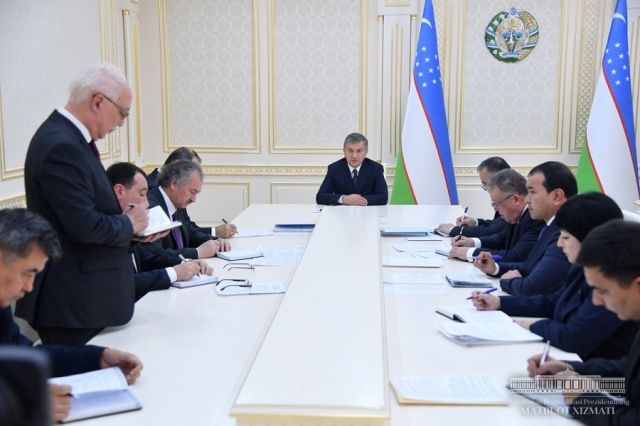
On December 25, 2017, a meeting devoted to current issues of the sphere of culture and art was held under the chairmanship of the President of the Republic of Uzbekistan Shavkat Mirziyoyev.
At present, particular attention is paid and large-scale activities are being held in the sphere of culture and art along with all spheres in our country.
The meeting of the President of our country Shavkat Mirziyoyev with representatives of the creative intelligentsia, held on August 3 of this year, opened a new stage in development of the sphere. Relevant issues related to the development of national culture, literature and art, ways of solving problems, important tasks facing creative unions and state organizations were critically analyzed.
In the Address to the Oliy Majlis, presented by the President of the Republic of Uzbekistan on December 22, attention was also paid to the development of this sphere, the tasks facing the cultural and art figures on the spiritual development of our people and society were specifically stated.
At the meeting, reports of the heads of the Ministry of Culture of the Republic of Uzbekistan, the Academy of Arts and creative organizations on the execution of previously defined tasks, were heard. Their activities were critically evaluated, specific instructions were given on revitalizing and raising the level of activities carried out in the sphere.
Culture and art are a source of pride for every nation. All efforts on development of our culture and art are aimed at strengthening the sense of pride of our people, said the President of our country. Thinking about the future of people of Uzbekistan, first of all we must establish strong cultural and spiritual foundations.
Over the past year, consistent work has been carried out on development of the sphere. 8 decrees and resolutions on improving activities of the Ministry of Culture and institutions of its system were adopted.
3 million 133 thousand spectators watched the performances staged in 37 theaters operating in our country, in 2017. During the year, the population was provided services related to the sphere of culture for 6 billion 72 million sums.
Days of Culture of Uzbekistan and various art exhibitions were held in China, Russia, Germany, Turkmenistan, Kazakhstan, Kyrgyzstan, Tajikistan and other countries.
The analysis shows that, despite the implemented activities, there are many things to be done in the sphere, and tasks waiting for implementation, said the Head of our state.
At the meeting it was emphasized that the level of services in the sphere of culture rendered to people, including residents of remote areas, makhallas and villages, does not meet the present requirements. Specific instructions were given on strengthening their material and technical base for expanding opportunities of theaters.
The need to develop a program on development of activities of theaters for 2018-2022, accelerating the adoption of relevant resolutions on development of circus and national dance art in the country was noted.
225 recreation parks should have been built and reconstructed in our country in accordance with modern requirements in order to organize meaningful leisure activities, to ensure cultural rest of the population in 2011-2015. However, to date, repairing and equipping activities have been completed only in 140 parks, the planned works on 90 parks have not been provided due to a lack of funds that should have been allocated by sponsors and entrepreneurs.
At the meeting, a number of important tasks of the Ministry of Culture for the next year were revised and specified, specific deadlines for their implementation were determined. In particular, it was entrusted to critically examine the state of retraining and advanced training of workers in the sphere of culture and art, the activities of pop, dance and orchestral groups, to resolve current issues related to strengthening their material and technical base, organization of training of modern specialists for the sphere.
Intensive activity is being carried out on the execution of the resolution of the President of the Republic of Uzbekistan “On additional measures of developing and further improving activities of the Academy of Arts of Uzbekistan”. At the meeting, the existence of a number of shortcomings and problems in the activities of the Academy of Arts, subject to immediate elimination, were noted. Thus, reconstruction and repair of specialized boarding schools in Nukus, Bukhara and Shakhrisabz were not carried out in a timely manner. Activity on reconstruction of the Central Exhibition Hall of the Academy of Arts at the modern level is delayed, which limits the possibility of holding prestigious international exhibitions in our country.
At the meeting, the activity planned for 2018 on further improving activities of the Academy of Arts was thoroughly considered. In particular, the need was noted on establishment of an exchange of experience with the leading foreign centers of fine and applied art, special attention to the organization of exhibitions of our famous artists abroad.
The relevant leaders were given instructions on preparing a draft resolution on construction of student houses with 400 seats for the Republican Art College named after P.Benkov and 200 seats for the Republican College of Design.
The need for paying special attention to training qualified personnel for the sphere, creation of a new generation of textbooks and their wide introduction into the educational process, provision of educational institutions with modern pedagogical, information and communication tools, improving quality of education was also noted.
At the meeting it was emphasized that consistent continuation of activities on the material and moral support of creative and technical workers who work hard in the sphere of culture and art, including improvement of their housing conditions, social and medical provision, increasing their fees, realizing the potential of young talents are among the extremely important tasks.
We should never forget one thing: society will not progress without development of culture and art in our country, emphasized the Head of our state. The level of development of our people will be assessed, first of all, on the basis of the national culture. Therefore, culture is the image of our people, society. Since we started creating a new image of Uzbekistan, we must begin this activity with the development of the national culture.
When millions of Muslims turn toward the Kaaba in Mecca for prayer, few may realize that the sweeping gold calligraphy on its iconic black cloth, the Kiswa, bears the legacy of a single artist — Abdul Rahim Amin Bukhari.
A master calligrapher from Mecca, Abdul Rahim Amin Bukhari dedicated his life to adorning Islam’s holiest site with words of divine beauty. His name, though not widely known outside Saudi Arabia, lives on in gold thread, etched into the sacred fabric that veils the Kaaba.
Abdul Rahim Amin Bukhari was born in 1917 in Mecca — a city pulsing with spiritual rhythm and Islamic tradition. As a boy surrounded by centuries-old mosques and devotional art, Bukhari was drawn to Arabic calligraphy early in life. What began as a childhood passion grew into a lifelong vocation.
At just 15, he joined the Kiswah Factory, newly established in 1927 by King Abdulaziz. This factory, devoted to producing the Kaaba’s annual covering, became the cradle of his artistic journey. Bukhari trained under the best, learning the subtle curves and disciplined elegance of classical scripts.
By the 1930s, he had risen to become chief technician, and eventually deputy director by the 1960s. His path was defined not only by artistic talent, but by humility and devotion.
Every year, the Kiswa is renewed — a majestic cloth of black silk, embroidered with Qur’anic verses in gold and silver thread. Its creation is a sacred task, and for decades, Bukhari was the pen behind its powerful script.
Specializing in the Thuluth script — a flowing, monumental style favored for religious inscriptions — Bukhari laid out every curve and flourish of the divine text. His designs set the standard, and to this day, artisans use his original layouts when crafting the Kiswa’s golden band (known as the hizam). His was not merely a job; it was an offering.
More than a technician, he was the soul of the Kiswa’s design. The gold lettering that millions of pilgrims see and touch was once inked by his hand on tracing paper, then embroidered stitch by stitch by a team he led and trained.
A Historic Commission: The Kaaba Door of 1944
One of the defining moments in Bukhari’s career came in 1944, when King Abdulaziz ordered the creation of a new door for the Kaaba. The old door, weathered by time, was to be replaced with a gilded masterpiece — and it was Bukhari who was asked to inscribe it with sacred text.
His calligraphy, rendered in bold Thuluth script, graced the new door’s copper and silver panels. The shahada (Islamic testimony of faith), the names of God, and select Qur’anic verses adorned its surface. These inscriptions were engraved into the metal by artisans, preserving Bukhari’s artistry in gleaming permanence.
This door, installed in 1947, became a symbol not just of royal generosity, but of spiritual craftsmanship. It was the first of two Kaaba doors Bukhari worked on — the second being the current door installed in 1979, which also features his calligraphy.
The Man Behind the Script
Though quiet and devoted, Bukhari’s work earned him respect at the highest levels. He wrote verses for early Saudi flags in the 1930s, crafted inscriptions for ceremonial mosque curtains, and even lettered the Rawdah curtain in Medina. King Faisal recognized his service by having Bukhari’s name woven into the Kiswa itself — a singular honor that continues to this day.
Visitors to Mecca who gaze upon the Kaaba’s belt will find his name hidden in gold — Abdul Rahim Amin. It is a subtle yet profound tribute to the man who helped shape the visual identity of Islam’s holiest structure.
A Living Legacy in Silk and Gold
Even after his passing in the late 1990s, Abdul Rahim Amin Bukhari’s calligraphy remains alive, literally sewn into the Kaaba each year. His templates are still used for the Kiswa’s verses, his scripts guide modern artisans, and his legacy continues to bridge art and worship in the most sacred way imaginable.
In the world of Islamic calligraphy, Bukhari stands as a pillar — not only for his mastery of pen and ink, but for how his work sanctified space. Every Muslim who looks at the Kaaba is unknowingly reading the words he shaped. Every stitch of gold thread reflects his lifelong devotion to making divine words beautiful.