The site is working in test mode!
07 December, 2025   |   16 Jumādá al-ākhirah, 1447

Tashkent city
Fajr
06:10
Sunrise
07:35
Dhuhr
12:20
Asr
15:13
Maghrib
16:58
Isha
18:16
Bismillah
07 December, 2025, 16 Jumādá al-ākhirah, 1447

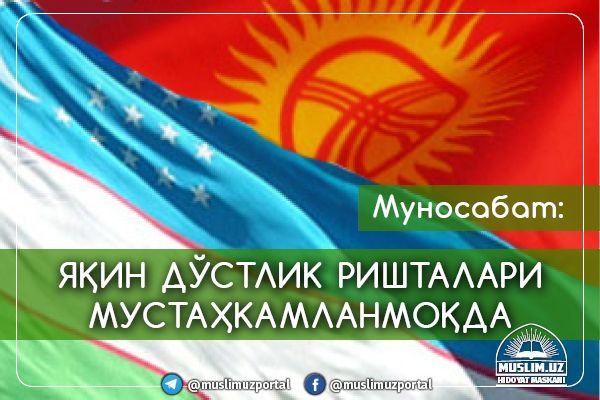
Close friendship relationships are strengthening.

15.12.2017   14339   4 min.
Close friendship relationships are strengthening.

Uzbek and Kyrgyz people have been living shoulder to shoulder for centuries. The root of these nations is the same. They lived in peace by exchanging in marriages.

Two great writers and state figures Chingiz Aytmatov and Sharof Rashidov were close friends.

After acquiring independence, Uzbekistan and Kyrgyzstan established diplomatic relations. In 1992 Kyrgyzstan opened its embassy, while Uzbekistan opened its embassy in Bishkek in 1998. In 1996 two countries signed “Agreement on Eternal Friendship” which became legal basis for the relationship for two countries. 181 official documents had been signed until 2005.

But the issue of using trans-border rivers has lately caused misunderstanding between two countries.

Nowadays these two countries which have missed previous ties are renovating their relationships now. Sooranbay Jeenbekov, President of Kyrgyzstan paid an official visit to Uzbekistan.

“Kyrgyzstan is our close neighbor. That’s why there should not be any border between us. We opened our hearts to each other and for this reason we need to solve any issue”, said President of Uzbekistan. 

In its turn, Sooronbay Jeenbekov expressed deep gratitude to Shavkat for the invitation and on behalf of people conveyed deep respect. President of Kyrgyzstan highly evaluated the efforts of Shavkat Mirziyoyev by saying: “You have turned our borders into real friendship, good neighborhood and partnership borders.”

Uzbekistan’s foreign policy highlights the importance of development successful relationships with neighbors. It has lately been observed an active integration process among Central Asian countries. Particularly, relations with Kyrgyzstan are leveling up. Visits between governmental bodies are widening.

During the meeting President Jeenbekov stressed his support for the President Mirziyoyev’s initiative for organizing constant advisory meetings with Central Asian leaders.

It is meaningful here to mention the participation of Maksatbek Toktomeshov, Muftiy of Kyrgyzstan at the International Scientific-practical conference called “Islamic solidarity in the example of Uzbekistan and Azerbaijan” which was hosted by Uzbekistan in Tashkent on October 18th of the current year. Muftiy of Kyrgyzstan Maksatbek Toktomeshov:

  • We, most of the participants of the conference, recognized each other, because our administrative office was the same before. Our fathers and grandfathers studied in this land in Tashkent and Bukhara. We are planning to open new religious institutions in our country, but for the time being we have to use educational establishments in Uzbekistan as this country has great religious knowledge and experience. I was thinking about this during the conference. The conference has become a great step forward for improving our warm relationships.

The visit of President of Kyrgyzstan to Uzbekistan will bring our relationships into new level. For this reason people of both countries are observing with great positive hopes.


Press service,

Muslim Board of Uzbekistan

Other posts
News

Abdul Rahim Amin Bukhari: The Calligrapher Who Left His Mark on the Kaaba

27.10.2025   15765   6 min.
Abdul Rahim Amin Bukhari: The Calligrapher Who Left His Mark on the Kaaba

When millions of Muslims turn toward the Kaaba in Mecca for prayer, few may realize that the sweeping gold calligraphy on its iconic black cloth, the Kiswa, bears the legacy of a single artist — Abdul Rahim Amin Bukhari.

A master calligrapher from Mecca, Abdul Rahim Amin Bukhari dedicated his life to adorning Islam’s holiest site with words of divine beauty. His name, though not widely known outside Saudi Arabia, lives on in gold thread, etched into the sacred fabric that veils the Kaaba.

Abdul Rahim Amin Bukhari was born in 1917 in Mecca — a city pulsing with spiritual rhythm and Islamic tradition. As a boy surrounded by centuries-old mosques and devotional art, Bukhari was drawn to Arabic calligraphy early in life. What began as a childhood passion grew into a lifelong vocation.

At just 15, he joined the Kiswah Factory, newly established in 1927 by King Abdulaziz. This factory, devoted to producing the Kaaba’s annual covering, became the cradle of his artistic journey. Bukhari trained under the best, learning the subtle curves and disciplined elegance of classical scripts.

By the 1930s, he had risen to become chief technician, and eventually deputy director by the 1960s. His path was defined not only by artistic talent, but by humility and devotion.

Every year, the Kiswa is renewed — a majestic cloth of black silk, embroidered with Qur’anic verses in gold and silver thread. Its creation is a sacred task, and for decades, Bukhari was the pen behind its powerful script.

Specializing in the Thuluth script — a flowing, monumental style favored for religious inscriptions — Bukhari laid out every curve and flourish of the divine text. His designs set the standard, and to this day, artisans use his original layouts when crafting the Kiswa’s golden band (known as the hizam). His was not merely a job; it was an offering.

More than a technician, he was the soul of the Kiswa’s design. The gold lettering that millions of pilgrims see and touch was once inked by his hand on tracing paper, then embroidered stitch by stitch by a team he led and trained.

A Historic Commission: The Kaaba Door of 1944

One of the defining moments in Bukhari’s career came in 1944, when King Abdulaziz ordered the creation of a new door for the Kaaba. The old door, weathered by time, was to be replaced with a gilded masterpiece — and it was Bukhari who was asked to inscribe it with sacred text.

His calligraphy, rendered in bold Thuluth script, graced the new door’s copper and silver panels. The shahada (Islamic testimony of faith), the names of God, and select Qur’anic verses adorned its surface. These inscriptions were engraved into the metal by artisans, preserving Bukhari’s artistry in gleaming permanence.

This door, installed in 1947, became a symbol not just of royal generosity, but of spiritual craftsmanship. It was the first of two Kaaba doors Bukhari worked on — the second being the current door installed in 1979, which also features his calligraphy.

The Man Behind the Script

Though quiet and devoted, Bukhari’s work earned him respect at the highest levels. He wrote verses for early Saudi flags in the 1930s, crafted inscriptions for ceremonial mosque curtains, and even lettered the Rawdah curtain in Medina. King Faisal recognized his service by having Bukhari’s name woven into the Kiswa itself — a singular honor that continues to this day.

Visitors to Mecca who gaze upon the Kaaba’s belt will find his name hidden in gold — Abdul Rahim Amin. It is a subtle yet profound tribute to the man who helped shape the visual identity of Islam’s holiest structure.

A Living Legacy in Silk and Gold

Even after his passing in the late 1990s, Abdul Rahim Amin Bukhari’s calligraphy remains alive, literally sewn into the Kaaba each year. His templates are still used for the Kiswa’s verses, his scripts guide modern artisans, and his legacy continues to bridge art and worship in the most sacred way imaginable.

In the world of Islamic calligraphy, Bukhari stands as a pillar — not only for his mastery of pen and ink, but for how his work sanctified space. Every Muslim who looks at the Kaaba is unknowingly reading the words he shaped. Every stitch of gold thread reflects his lifelong devotion to making divine words beautiful.