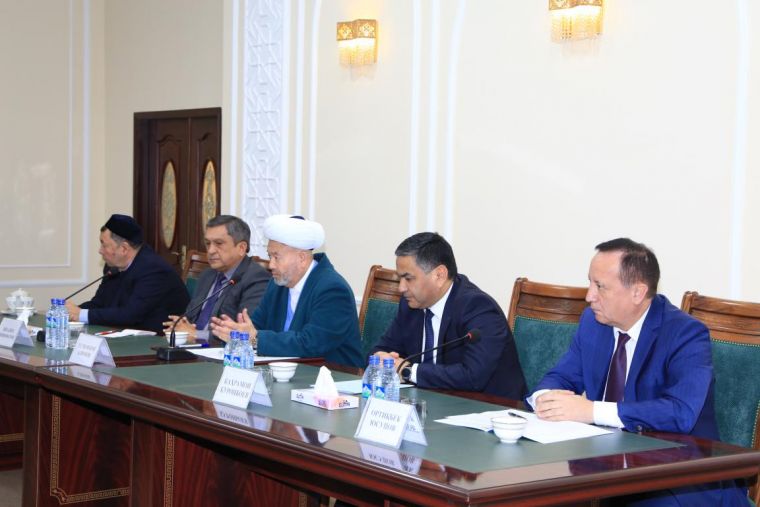
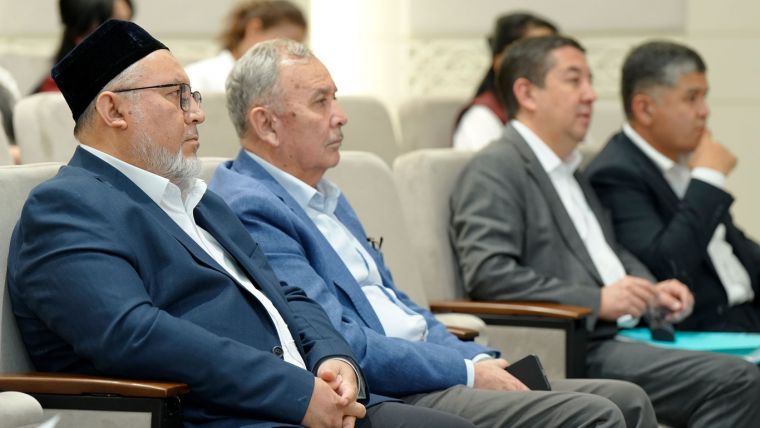
The new partnerships and scientific and cultural projects being established in the international media sphere are taking the international activities of the Islamic Civilization Center in Uzbekistan to a new stage. As the next phase of the cooperation initiated during the recently held international media forum “Islamic Civilization: A New Perspective — New Discoveries,” a special presentation, an international scientific and practical conference, and an exhibition are planned to be held at UNESCO Headquarters in Paris. The outcomes of these projects and the preparations for them were discussed at the latest meeting of the academic council of the Islamic Civilization Center in Uzbekistan.
The meeting was attended by members of the academic council, scholars and researchers, as well as staff responsible for the relevant areas.
The meeting began with an analysis of the results of the international media forum. As noted, the forum served as an important platform for dialogue, enabling the Center to present its activities more broadly in the international information and academic spheres and to establish new professional contacts with foreign journalists, media experts, scholars, and researchers.
During the forum, participants exchanged views on the Center’s scientific and research potential, the heritage of Islamic scholarship and culture that developed in the territory of Uzbekistan, as well as opportunities to present this heritage to international audiences through modern media platforms. It was emphasized that the interest shown by representatives of foreign media in the Center’s activities, along with the discussions held with them, had created new opportunities for future cooperation.
In this regard, future tasks were outlined to consistently develop the contacts established during the forum, build systematic cooperation with international and local media outlets, and promote the Center’s scientific projects and research more widely among international audiences.
At the academic council meeting, particular attention was paid to preparations for one of the promising projects aimed at taking the Center’s international scientific and cultural cooperation to a new level — a special presentation, an international scientific and practical conference, and an exhibition planned to be held at UNESCO Headquarters in Paris.
Through these events, the aim is to more broadly introduce to the international academic community the scientific and research activities of the Islamic Civilization Center in Uzbekistan, established on the initiative of President Shavkat Mirziyoyev, as well as the role of the scientific, educational, cultural, and historical heritage that developed in the territory of Uzbekistan in the advancement of world civilization.
Work is currently underway within the framework of the project to involve international scholars and researchers in the events, establish cooperation with scientific institutions and international organizations, develop the presentation and conference program, and prepare the exhibition displays in terms of both academic content and overall substance.
Komiljon Shermuhammedov, Director of the Imam Maturidi International Scientific Research Center, provided information on preparations for the events in Paris:
“Invitations have been sent to around 50 scholars and researchers from France. Relevant work is also being carried out to involve representatives of other international organizations and scientific institutions.
Another important part of the event is the exhibition project to be organized at UNESCO Headquarters. Through five exhibition sections, it is planned to present to the international community key aspects of the scientific, cultural, and historical heritage that developed in the territory of Uzbekistan. Work is underway to display 35 significant artifacts, around 200 ancient books, as well as models of historical monuments.”
Members of the academic council also exchanged views on the substance of these projects, their academic grounding, and the methods of presenting them to an international audience.
In particular, it was noted that, in developing the exhibition displays, it is important to present the scholarly value of historical sources, the historical significance of the artifacts, and their connection to the development of Islamic civilization in the territory of Uzbekistan on the basis of accurate and reliable information.
It was also emphasized that the materials to be presented to international audiences should extensively cover the scholarly schools that emerged in the territory of Uzbekistan, the contributions of great scholars to the development of world science and culture, and the work currently being carried out to study and promote this scientific and educational heritage.
At the conclusion of the meeting, relevant tasks were identified to build on the outcomes of the international media forum through practical projects, further expand cooperation with foreign media outlets and scientific institutions, organize preparations for the events planned at UNESCO Headquarters in Paris at a high level, and widely promote the Center’s scientific and research activities, as well as Uzbekistan’s rich Islamic scientific and cultural heritage, on the international stage.
iccu.uz



 Iman
Iman  Prayer
  Fasting
  Zakat
Zakat  Haj
Haj  Qur`an
  Lessons of Islam
  Contact