The site is working in test mode!
14 August, 2026   |   1 Rabī‘ al-awwal, 1448

Tashkent city
Fajr
04:02
Sunrise
05:31
Dhuhr
12:28
Asr
17:21
Maghrib
19:28
Isha
20:54
Bismillah
14 August, 2026, 1 Rabī‘ al-awwal, 1448

Pilgrimage Tourism between Uzbekistan and Indonesia enters a new phase of advancement

14.07.2026   45955   4 min.
Pilgrimage Tourism between Uzbekistan and Indonesia enters a new phase of advancement

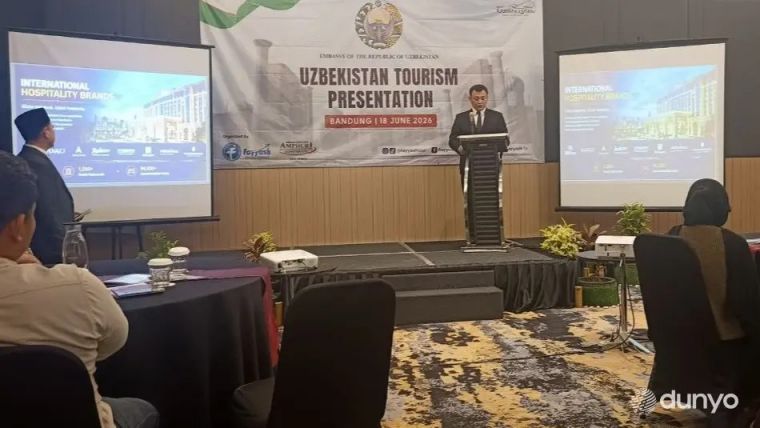
An event dedicated to the tourism potential of Uzbekistan was organized in Bandung, administrative center of West Java Province, reports Dunyo IA.

The event focused on extensively promoting the rich historical and cultural heritage, alongside the pilgrimage tourism opportunities of Uzbekistan, to the Indonesian public, while aiming to elevate bilateral tourism cooperation between the two nations to a fundamentally new level.

At the outset of the event, detailed insights were provided into the economic and demographic potential of West Java Province. With a population reaching approximately 51 million, this region stands as one of the largest and most economically advanced territories within Indonesia.

The province boasts a dynamic industrial landscape, characterized by the rapid development of the automotive, electronics, textile, chemical, logistics, and service sectors. Concurrently, West Java is widely recognized as a premier center for the Hajj and Umrah services market in Indonesia, driven by its predominantly Muslim population.

During the meeting, it was underscored that West Java is home to hundreds of licensed Hajj and Umrah tour operators, facilitating sacred journeys for hundreds of thousands of citizens annually, with the city of Bandung serving as a crucial religious and educational center. These overarching factors clearly demonstrate the vast, untapped potential for robust cooperation with Uzbekistan in the field of pilgrimage tourism.

The core segment of the event was dedicated to highlighting the paramount role of Uzbekistan's historic cities—Samarkand, Bukhara, Khiva and Termez - in Islamic civilization, showcasing the nation's sacred shrines, the rich heritage of great scholars, and the comprehensive institutional reforms executed in the tourism sector in recent years.

Concurrently, detailed information was provided regarding the modern tourism infrastructure, international standard hospitality networks, transport-logistics capacities, and the comprehensive facilities established for foreign guests.

Special video presentations highlighting the activities of the Center of Islamic Civilization in Uzbekistan and the Imam Al-Bukhari International Scientific Research Center were also showcased. The presentation generated immense interest among the participants.

Speaking at the event, the leadership of the West Java Hajj and Umrah Association emphasized the profound potential for expanding multifaceted cooperation with Uzbekistan. In their view, Uzbekistan stands as a pivotal cradle of Islamic civilization, and the sublime heritage of legendary scholars such as Imam Al-Bukhari, Imam Al-Tirmidhi and Bahauddin Naqshband carries immense spiritual and educational significance for the Indonesian Muslim community.

Furthermore, it was noted that the establishment of direct air connectivity between Jakarta and Tashkent will serve as a catalyst to elevate bilateral tourism cooperation to a fundamentally new level. Leading tour operators in West Java, including prominent agencies such as “DAGO Travel”, are expressing profound interest in the Uzbekistan market. Several operators highlighted their ongoing practice of facilitating travel for hundreds of Indonesian pilgrims to Uzbekistan annually.

The event participants emphasized that comprehensive tour packages encompassing historic cities such as Samarkand, Bukhara, and Termez hold exceptional appeal for Indonesian travellers.

At the conclusion of the event, the participants held detailed discussions on the procedures for traveling to Uzbekistan, visa regimes, air connectivity, hospitality infrastructure, and frameworks for close cooperation with local tour operators. This presentation served as a significant milestone in further expanding bilateral cooperation in the field of pilgrimage tourism, strengthening cultural and humanitarian ties, and driving a substantial increase in the influx of Indonesian tourists to the Republic.


 

Other posts
News

Cultural Significance and Centuries-Old Traditions of the Uzbek Mahalla discussed at UNESCO

14.08.2026   7757   4 min.
Cultural Significance and Centuries-Old Traditions of the Uzbek Mahalla discussed at UNESCO

Facilitated by the Permanent Delegation of Uzbekistan to UNESCO, an online meeting was held between representatives of Uzbekistan and the Secretariat of the 2003 UNESCO Convention for the Safeguarding of the Intangible Cultural Heritage, dedicated to the cultural traditions and practices associated with the mahalla, as well as prospects for their promotion at the international level, reports Dunyo IA.

UNESCO Convention for the Safeguarding of the Intangible Cultural Heritage was adopted in 2003 and aims to safeguard living cultural traditions, customs, knowledge, skills and forms of cultural expression transmitted from generation to generation by communities. Operating within the framework of the Convention are the Representative List of the Intangible Cultural Heritage of Humanity, the List of Intangible Cultural Heritage in Need of Urgent Safeguarding and Register of Good Safeguarding Practices.

On behalf of UNESCO, the consultation was attended by Fumiko Ohinata, Secretary of the Convention for the Safeguarding of the Intangible Cultural Heritage and Nicholas Tan, Associate Programme Specialist responsible for the Asia and the Pacific region. Uzbek side was represented by officials from the Ministry of Foreign Affairs, the Mahalla Association of Uzbekistan, the National Commission for UNESCO and Permanent Delegation of the country to UNESCO.

During the meeting, the Uzbek side presented the centuries-old history of the mahalla, its special role in the life of society and its significance in preserving national traditions. It was emphasized that the mahalla is an integral part of the lifestyle of the people of Uzbekistan, uniting individuals on the basis of the principles of good neighbourliness, mutual assistance, solidarity and respect for the older generation.

Particular attention was paid to the cultural dimension of the mahalla. For centuries, it has served as a space where traditions are preserved directly in people's daily lives: holidays and important family events are celebrated collectively, customs of mutual assistance are maintained, intergenerational relations are strengthened and knowledge, values and life experience are transmitted to the youth.

Representatives of the UNESCO Secretariat reviewed the presented materials with great interest and noted the distinct nature of the social lifestyle centered around the mahalla in Uzbekistan. During the conversation, the significance of the traditions of community life, cultural interaction and the intergenerational transmission of heritage was emphasized as vital components of living intangible cultural heritage.

UNESCO experts also noted that the value of such traditions lies in their constant presence in people's lives. Cultural heritage within the mahalla is not limited to the preservation of individual customs but continues to manifest itself in daily interaction, relations between neighbours, collective events, and the participation of different generations in the life of the community.

During the exchange of views, it was noted that the experience of the mahalla reflects the way of organizing community life characteristic of Uzbekistan, where cultural values are preserved by the people themselves, further developed, and transmitted to subsequent generations. UNESCO representatives emphasized that such forms of interaction within local communities could be of significant interest in the context of the “living heritage” concept that underpins the 2003 Convention.

The role of Uzbekistan in promoting intangible cultural heritage and its contribution to enhancing international awareness of the diversity of living cultural traditions were separately highlighted. In this regard, the presented experience of the Uzbek mahalla generated significant interest among the Secretariat specialists.

Consultation held marked another step in developing cooperation between Uzbekistan and UNESCO on the preservation and international promotion of the country’s rich intangible cultural heritage, including the unique traditions and values formed within the institution of the mahalla.