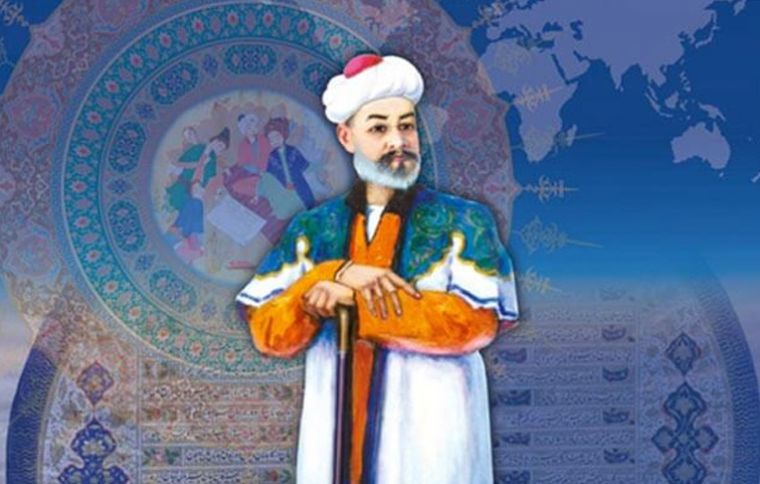
Mir Alisher Navoi was a great poet, thinker, a linguist and a statesman. His full name was Nizomiddin Mir Alisher Navoi. He is the outstanding figure of Uzbek literature, known in the West as Chagatai literature. There is no greater personality than him in the literature of the Turkic peoples. He was a founder of Uzbek literature. Mir Alisher Navoi knew languages. He knew the Arabic, Persian and Turkic languages very well. Mir Alisher Navoi’s contribution to the world civilization is great. We will celebrate his 584th anniversary widely this year.
He wrote his poems under the pen-names of Navoi (in his poems which were written in the old Uzbek language) and Foni (in his poems which were written in Persian language).
He was born on February 9, 1441 in Herat and spent the main part of his life there. He studied in various educational establishments of Herat, Mashhad and Samarkand (in Ulugbek madrasah). Mir Alisher Navoi's family was close to Timurid's palace. According to the information of great historian Giyasiddin Hondamir, an old poet Mavlona Lutfi met with Mir Alisher Navoi, when he was a child and Mavlona Lutfi appreciated his talent.
Famous poet and thinker Abdurahmon Jomi was the teacher and adviser of Mir Alisher Navoi,
Mir Alisher Navoi had no his own family. He dedicated his life to the science, the young people who studied and trade. He always wanted people to be educated and helped them.
One of the Timurid's Sulton Husayn Boyqaro took the crown of Herat in 1469, and a new period began in Mir Alisher Navoi's life. In 1469 he was given a title as a stamper and in 1472 as a minister (vazir) of the state by Husayn Boyqaro. Mir Alisher Navoi was famous as a poet and a statesman, he owned a great wealth at that time. During 1480 he built a number of madrasahs, 40 robots (the place where karavan could have a little rest), 17 mosques, 10 honaqohs, 9 bath-houses, 9 bridges, 20 pools in Herat and in other parts of the country for his own money (from his own account). Mir Alisher Navoi was sent to Astrobod as a governor (head) in 1487. Husayn Boyqaro gave a title to Navoi as "Muqarribi hazrati sultoniy (the closest person to sultan)". One of the main features of that title was that who could do state work instead of Husayn Bayqaro.
The great poet Mir Alisher Navoi died on 3rd of January in 1441 in Herat. He was buried in Herat (in Afghanistan).
According to the capacity of Mir Alisher Navoi's "Hamsa" includes the following dostons (plays): "Hayratu-l-abror", "Farhod va Shirin", "Layli va Majnun", "Sab'ai sayyor" and "Saddi Iskandariy". Mir Alisher Navoi Navoi was the first poet who created completed "Hamsa" in Turkic language (the old Uzbek language) and proved that such great work could be written in the Turkic language.
The problems which are connected with the leader were the main plan in "Sab'ai Sayyor" and "Saddi Iskandariy" which are the parts of "Hamsa". In the tradition of writing Hamsa Mir Alisher Navoi's "Hamsa" is distinguished with its social-political character and being original. Having read Navoi's "Hamsa" Abdurahmon Jomi was impressed and appreciated his work.
Mir Alisher Navoi's thoughts, the quintessence of philosophical views - tasavvufiy ideas of the last days of his life were described in "Lisonu-t-tayr" .
During 1491-1498 Mir Alisher Navoi created 4 devons (collection) called "Hazoinu-l-maoniy". The general capacity of it is more than 50000 verses. There were 21 lyric genres in Eastern literature and Navoi used 16 of them in his poems. The collection of his poems in the Persian language is called "Devonu Foni". These two devons include 3150 poems which were written in gazal genre. Mir Alisher Navoi collected his qasidas in Persian and made 2 miscellane as called "Sittai Zaruriya: ("Olti Zarurat") and "Fusuli arbaa" ("Four seasons").
Mir Alisher Navoi's "Muhokamatu-l-lugatayn" is devoted to the comparative analysis of Turkish and Persian. His tazkira "Majolisun-nafois" was written in the way of literary criticism. His "Mezon ul-avzon" was written about the theory of aruz, "Mufradot" was written about the rules of problems.
Also he created the works called "Tarixi muluki ajam", "Tarixi anbiyo va hukamo". In the base of his collection called "Munshaot". In memorialistic genre he wrote "Hamsatu-l-mutaxayyirin" ("Besh hayrat") devoting to Abdurahmon Jomi (1494), "Holoti Sayyid Hasan Ardasher"). In Mir Alisher Navoi's nasriy work "Mahbubu-l-qulub" (1500) the social and political thoughts were expressed in high level.
Mir Alisher Navoi knew languages. He knew the Arabic and Persian languages very well.
His contribution is great in the world civilization. Mir Alisher Navoi’s works are translated into many languages in the world. Throughout his life, Mir Alisher Navoi combined literary works with politics. Being a high-ranking official, he made a significant contribution to the socio-economic development of the country; He sponsored the development of science and art, and always strived for peace and harmony.
Mir Alisher Navoi put forward the global problems with the sufizm in his poetry.
After the independence of the Republic of Uzbekistan Navoi's poems about religion and sufizm are widely studied. Especially from this point of view the objective study of Navoi's poems are increased. The religious poems of Navoi called "Arbain", "Munojot" were adopted firstly. The work "Nasoyimu-l-muhabbat", which includes information about 750 shayxs of tasavvuf was adopted.
Mir Alisher Navoi left rich literary heritage. The great Uzbek poet, thinker, philosopher, creator is the author of unique works, more than thirty collections of poems, prose works, major poems and scientific. His creativity is great. The volume of his six poems is about 60.000 lines (misra). In 1483-85, Mir Alisher Navoi created the work "Khamsa" ("Five"), which consisted of poems: "Khairat al-Abrar" ("Confusion of the Righteous"), "Farhad va Shirin" ("Farhad and Shirin"), "Leyli va Mazhnun", "Sabai Sayyar" ("Seven Planets"), "Saddi Iskandari" ("Wall of Iskandar"). They were created on the basis of the hamsa tradition - the creation of five (five poems)."Hamsa" Navoi - the first work in the genre of serials, created in the Turkic language. He proves that such a voluminous work can be created in the Turkic language.
There are many manuscripts and printed copies of Mir Alisher Navoi's "Hamsa" in Central Asia 166 manuscripts which were copied during XV-XX centuries, are kept in the fund of manuscripts of the Institute Oriental Languages in the Academy of Sciences of Uzbekistan. In 84 of them all dostons (plays) of pentas are given in it.
254 handwritings of 24 works of Mir Alisher Navoi are kept in the Academy of Sciences of Uzbekistan, in the Institute of Oriental Languages (3rd fund).The list of handwriters who copied the works of Mir Alisher Navoi and some information about them can be a risola.
Although Alisher Navoi passed away many centuries ago, his literary heritage and contributions to the Enlightenment continue to endure. Today, he is celebrated as a national hero in Uzbekistan, and his wise words continue to inspire people.
Used Internet sites
1.ziyuz.uz
2. uzbekistan.travel
3.yandex.uz
4.ziyoratga.uz
Fakhriddin Ernazarov



 Iman
 Prayer
 Fasting
 Zakat
 Haj
 Qur`an
 Lessons of Islam
 Contact